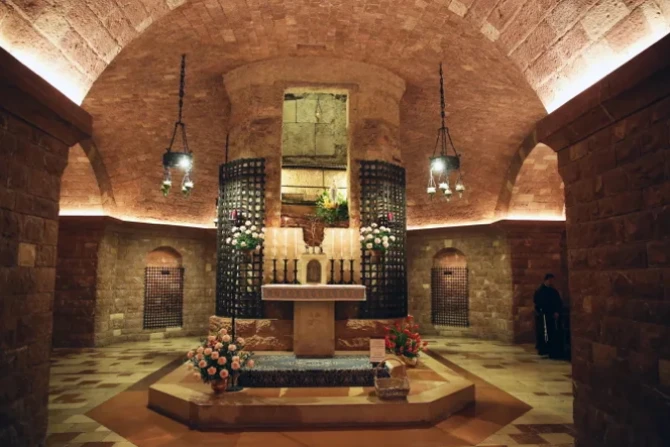
For the first time, the body of St. Francis of Assisi will be visible to all, from Feb. 22 to March 22, 2026. This religious and historical event was announced on the memorial of the saint of Assisi (Oct. 4) and will coincide with the eighth centenary of the death of St. Francis in 1226.
The announcement was made from the Loggia delle Benedizioni by Fray Giulio Cesareo, director of the press office of the Sacred Convent, following Mass celebrated in the Upper Basilica of the Umbrian city, presided over by Monsignor Camillo Cibotti, president of the Episcopal Conference of Abruzzo and Molise, along with Cardinal Ángel Fernández Artime, papal legate for the papal basilicas of Assisi, the bishop of Assisi, and the general and provincial ministries of the Franciscan families.
In his homily, Cibotti emphasized the “newness of life” that Francis presents to the world. “A new way of feeling, of thinking, of living Christ,” Cibotti noted. The mayor of L’Aquila, Pierluigi Biondi, lit the votive lamp of the Municipalities of Italy, representing the Italian people during the celebration.
The first part of the celebration for the feast of St. Francis, patron saint of Italy, concluded with speeches from the authorities from the loggia of the sacred convent. Reference was also made to the reinstatement of Oct. 4 as a national holiday in that country.
“In recent days, Parliament approved the law making Oct. 4 a national holiday,” declared the custos of the Sacred Convent, Friar Marco Moroni, OFMConv, at the beginning of the celebration in the basilica. “This is not just a tribute to the patron saint of Italy, but a recognition of values that speak to everyone. For this celebration to be truly fruitful, everyone must draw concrete consequences from it: our communities with their daily lives; local governments with their choices for justice and inclusion; Parliament and the government with laws and policies consistent with what is proclaimed today; each of us with sober and fraternal lifestyle choices.”
Prime Minister Giorgia Meloni, also present at the celebration, addressed Italy from the loggia of the Sacred Convent: “The devotion of Italians to St. Francis is strong, authentic, and visceral, which can be seen in the faces of the pilgrims present here. Today the Italian people turn their gaze here, to Assisi, because St. Francis is one of the founding figures of the Italian identity. Francis of Assisi was a man of action, extreme but not extremist. Today we celebrate Francis not because he needs us, but because we need him.”
At the celebration the exposition of the remains of St. Francis in 2026 was also announced. The press release from the Sacred Convent of Assisi stated: “This exposition, rooted in the evangelical theme of the seed that dies to bear fruit in love and brotherhood, invites us to consider the life of the saint, who continues to bear fruit after 800 years and to inspire all humanity on the path of peace, brotherhood, service to the least, joy and care for creation.”
“The eighth centenary of the death of St. Francis, in 2026, is a time of remembrance and renewal. We do not celebrate death, but, recognizing it as a ‘sister’ to St. Francis, we celebrate the life that blossoms from the gift and offering of self,” the statement continued.
“It is in this spirit that, thanks to the approval granted by the Holy Father Leo XIV through the Vatican Secretariat of State, the public display of his mortal remains will take place,” the statement said.
The body of St. Francis will be moved from his tomb, located in the crypt, and placed at the foot of the papal altar in the lower church of the Basilica of St. Francis. The tomb’s history itself holds significant historical and religious significance: after the death of the Poverello saint, “the body was made inaccessible,” the press office of the Sacred Convent explained, “beneath the basilica’s high altar to prevent any possible theft. It remained hidden for centuries, until, after a long and arduous search, it was finally discovered on the night between Dec. 12 and 13, 1818.”
The first official recognition took place in 1819, confirming the identity of the remains of the saint of Assisi. There are also other recognitions, such as the one in 1978, in preparation for the 750th anniversary of his death, and the most recent one in 2015.
For more information: www.sanfrancescovive.org
This story was first published by ACI Stampa, CNA’s Italian-language news partner. It has been translated and adapted by CNA/ACI Prensa.