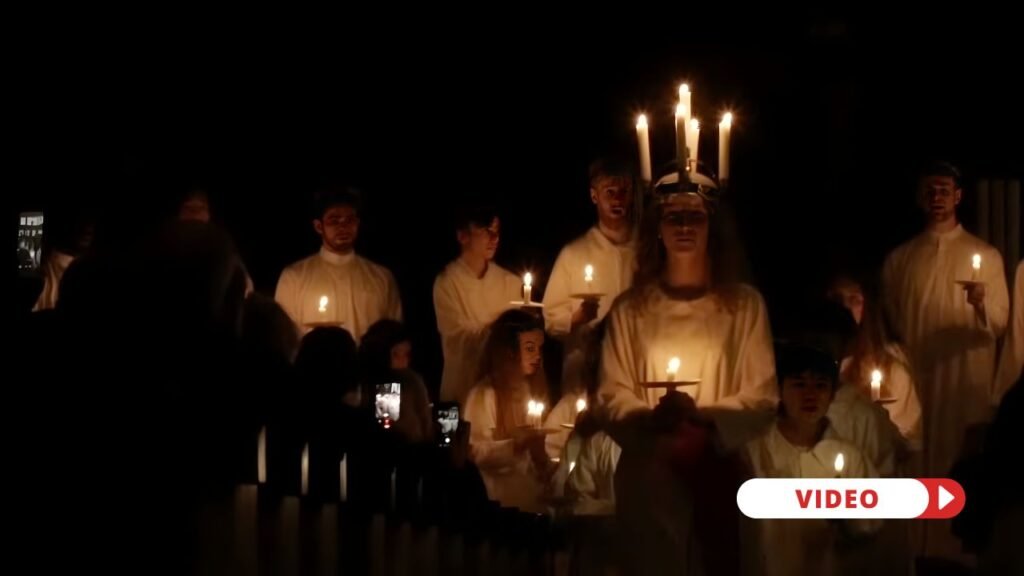
Candles, processions, and songs of light mark one of Scandinavia’s most cherished traditions. In the heart of winter, when darkness dominates the Nordic landscape, St. Lucy’s Day transforms December into a luminous celebration of hope.
A Festival of Light in the Darkest Days
Although Nordic societies today are largely secular, the figure of St. Lucy — the “bearer of light” — continues to hold a special place, particularly in Sweden. Each year on December 13, the early Christian martyr is honored with candlelit processions in schools, town squares, and churches. The celebration is embraced by believers and non-believers alike, offering a shared cultural moment rooted in light and beauty.
For many years, this Swedish tradition has also found its way to St. Peter’s Basilica, brought by high school students from Sweden studying music, who share their heritage through song and ceremony.
Reflecting on the meaning of the celebration, Fabienne Glader, a student at Nordiska Musikgymnasiet in Sweden, explained why St. Lucy resonates so deeply during this season.
“This time in Sweden, in December, it’s the darkest time of the year,” she said. “And I think she is the one who brings the light to Sweden, kind of. She brings all the candles, she brings all the lights because it’s so completely dark.”
Light, Darkness, and the Story of St. Lucy
The symbolism of St. Lucy’s Day is closely tied to Sweden’s dramatic seasonal contrasts. Alfio Tota, also a student at Nordiska Musikgymnasiet, noted how deeply light and darkness are woven into Swedish culture.
“In the Swedish tradition, almost all of the most important holidays are connected to light and darkness, since we have so extreme seasons,” he said. “So, the story of St. Lucy really plays with these contrasts of light and dark, and most importantly, hope and despair.”
St. Lucia of Syracuse was born around 283 AD in Sicily to a wealthy Christian family. From a young age, she devoted herself to Christ and to caring for the poor. Refusing marriage to a pagan suitor, she chose a life of chastity, prayer, and service. Her unwavering faith led to persecution during the reign of Emperor Diocletian and ultimately to her martyrdom around 304 AD.
For many young people today, her witness remains inspiring beyond religious boundaries. Reflecting on her legacy, Glader emphasized St. Lucy’s human virtues.
“She shows courage and patience and just to never let down on yourself and always keep pushing forward,” she said. “And I think for everyone really, even if you’re not really religious in any way, you can look up to her as just a wonderful person.”
A Living Tradition and a Lasting Longing
In the traditional Swedish St. Lucia procession, Lucy wears a crown of lit candles to light her way, leaving her hands free to carry food for others. She is accompanied by handmaids dressed in white robes symbolizing purity, while her red sash recalls her martyrdom. The processions are accompanied by “Lucia songs,” hymns that speak of Christ’s peace and proclaim the joy of His coming.
For Casimir Käfling, another student at Nordiska Musikgymnasiet, the tradition is deeply personal. He explained how St. Lucy has shaped both his musical and cultural upbringing.
“I’ve been singing in a choir, and I’ve been around church music my entire life,” he said. “So, well, St. Lucy, I’ve always really had her in the back of my mind, and always every Christmas or every Advent, I’m involved in the tradition of St. Lucy. So, yeah, she’s a big part of my upbringing and she’s a big part of my overall culture.”
Ultimately, St. Lucy endures as a symbol of Christ’s light triumphing over darkness, especially in the heart of winter. While the celebration may no longer be closely tied to active Catholic practice for many, it remains a powerful reminder of Sweden’s Christian roots and a shared longing for hope.
As Käfling reflected, the tradition continues because it speaks to something deeply human.
“St. Lucy is bringing light into darkness,” he said. “And so, I think that works very well hand in hand with what every Swede hopes for, and that is light in the darkness. So I think that’s a reason why it’s become so big and so popular in Sweden, is because it plays on what every Swede kind of has in his back mind and what they long for.”
Adapted by Jacob Stein. Produced by Alexey Gotovskiy; Camera by Andrea Manna, Mikhail Aijan; Video edited by Giada D’Ottavi.