SIGN UP FOR OUR NEWSLETTER HERE
Standing before the majestic Saint Peter’s Basilica, there’s no better place to introduce the EWTN Travel Jubilee app—your essential companion for the Jubilee Year in Rome. Designed for pilgrims and travelers alike, this app unveils hidden gems, provides key details on sacred sites, and guides you to the Holy Doors of the major papal basilicas. With access to exclusive EWTN content, Vaticano videos, and even ticket purchases for the Vatican Museums and Omnia Card, it’s never been easier to navigate the Eternal City.
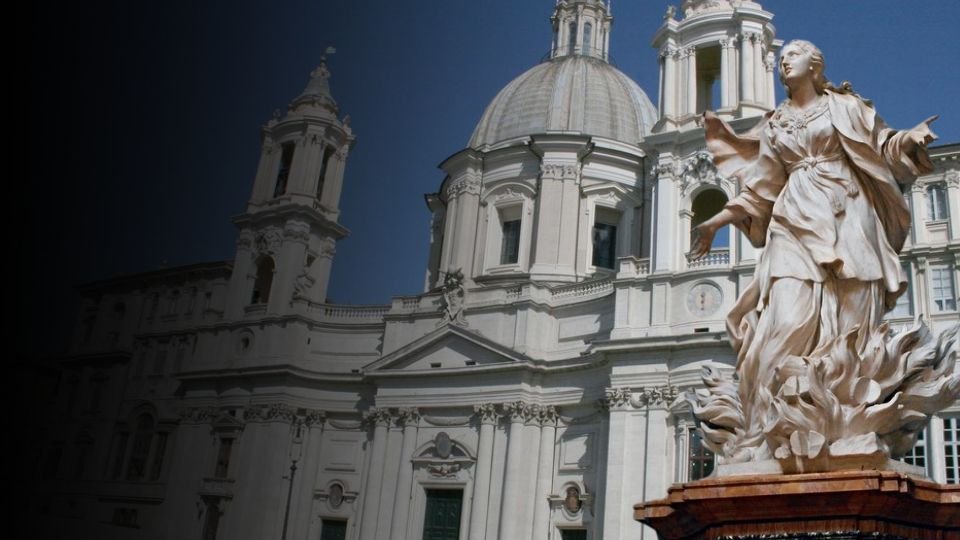
Thanks to our partnership with the Diocese of Rome, we’re bringing this invaluable resource straight to your fingertips. In this episode of Vaticano, we explore one of the remarkable churches featured in the app—Sant’Agnese in Agone, nestled beside the iconic Piazza Navona. Join us as Father John D’Orazio from the Rome Diocese Pilgrimage Center leads us through its rich history and spiritual significance:
“We found ourselves in a hidden gem inside of the city of Rome. We are down beneath the Church of St. Agnese at Piazza Navona, which is of great significance because it is a place of the martyrdom of St. Agnes, who was one of the first martyrs of Christianity.
“And this is the place of her martyrdom.
“We are down below the Stadium of Domitian, in an area that was a brothel, and St. Agnese was thrown into that brothel because she refused to sacrifice to the goddess of virgins, Vesta. She had chosen to become a virgin herself because she wanted to be betrothed to Christ.
“The legend has it that some of the sons of the prefect of Rome had asked for her hand in marriage, but she had the audacity to refuse him because she didn’t want to betray her promise to Christ in consecrating her virginity to Christ.
“When she was martyred, she was thrown to the flames first, but the flames didn’t devour her. We see the depiction of flames; it is hard to see them, but there are flames and the cross above the flames.
“This is a very ancient space. There is this mosaic floor that is typical for the ancient churches in Rome. This was an ancient chapel, then a medieval chapel, and then the church we see today was built on top of this.
“The main church that we see today goes back to the time of Baroque Rome in the 17th century, at a time when churches were embellished in a manner such as to create and inspire awe.
“Behind us here is a statue of St. Agnese, depicted in the scene of her martyrdom with the flames that are unable to touch her. They depart to one side and another before she is finally martyred as a lamb.
“Here we have a relic of St. Agnes, her skull, that was brought over from the catacombs. She was buried in the catacombs of Via Nomentana, but this relic, as the remembrance of her martyrdom, was brought back to this church that was built over the place of her martyrdom.”
Thank you for joining us on this journey through the Eternal City. If you haven’t yet, be sure to download the EWTN Travel Jubilee app—your guide to discovering Rome’s hidden gems and sacred sites. Whether you’re planning a pilgrimage in person or making a spiritual journey from home, the app brings the beauty and history of the Jubilee Year right to your fingertips.
Even if you can’t make it to Rome, you can still explore its treasures through virtual pilgrimages and exclusive content. Download the app today and embark on your journey of faith. Buon viaggio!
CLICK HERE TO DOWNLOAD ON Google Play Store
CLICK HERE TO DOWNLOAD on APPLE store
Adapted by Jacob Stein