In the heart of Rome, away from the great basilicas most pilgrims immediately associate with the Eternal City, there is a place that has preserved the memory of St. Francis of Assisi for more than 800 years.
The Church of San Francesco a Ripa, in the historic neighborhood of Trastevere, stands near what was once the ancient Port of Ripa Grande.
According to Franciscan tradition, this is the only place in Rome where St. Francis is known to have lived and prayed.
Behind the church’s doors are traces of his visits to Rome: the room where he stayed, a stone traditionally believed to have served as his pillow, and one of the earliest portraits of the saint.
But San Francesco a Ripa is not simply preserving Francis’ past.
Eight centuries later, the friars who live there are continuing his mission by opening their home to young people fleeing war, poverty and hardship.
Why St. Francis Came to Rome
Francis first came to Rome with his earliest companions in 1209.
His small fraternity was growing, and Francis wanted the Church’s approval for the new way of life they had embraced.
It was the beginning of a long journey that would eventually lead to the formal approval of the Franciscan Rule in 1223.
While in Rome, Francis found lodging in Trastevere.
Fr. Danilo Di Vincenzo, OFM, a Friar Minor and Deputy Director of the Ripa Project, explains that the site was then home to a hospice and hospital dedicated to St. Blaise, or San Biagio.
Established by Benedictine monks from the nearby Abbey of San Cosimato, the hospice welcomed pilgrims as well as the sick, poor and suffering.
It was an environment Francis would have recognized.
His conversion in Assisi had been profoundly shaped by his encounters with lepers and those living on the margins of society. In Rome, he once again found himself among people in need.
Eventually, the site became permanently associated with the saint and took the name San Francesco a Ripa.
During the Franciscan Jubilee Year, the church also became a place where pilgrims could obtain a plenary indulgence under the conditions established by the Church.
The Room Where St. Francis Stayed
One of the most remarkable parts of San Francesco a Ripa is also one of the simplest.
Within the oldest section of the complex, the friars preserve the place where Francis is believed to have stayed and slept during his visits to Rome.
“We are here in the oldest part of the church,” Fr. Danilo explained, “which preserves the very place where Francis, most likely together with one of his companions, lived, stayed, and slept.”
For pilgrims accustomed to encountering St. Francis through paintings, statues and books, the room offers something different.
It connects them to the physical reality of his life.
Francis actually traveled these roads. He entered Rome. He needed somewhere to sleep. And according to tradition, it was here, among pilgrims and the poor, that he found shelter.
The Stone St. Francis Used as a Pillow
Among the objects preserved by the friars is an unusual Franciscan relic: a stone traditionally believed to have been used by St. Francis as a pillow.
It is a small detail, but one that powerfully evokes the radical poverty associated with the saint.
Francis had been born into a wealthy merchant family. As a young man, he dreamed of status and glory. His conversion led him in the opposite direction.
He embraced a life of poverty and simplicity in imitation of Christ.
The stone preserved at San Francesco a Ripa has therefore become more than a reminder of where Francis slept. For pilgrims, it points toward the simplicity he deliberately chose.
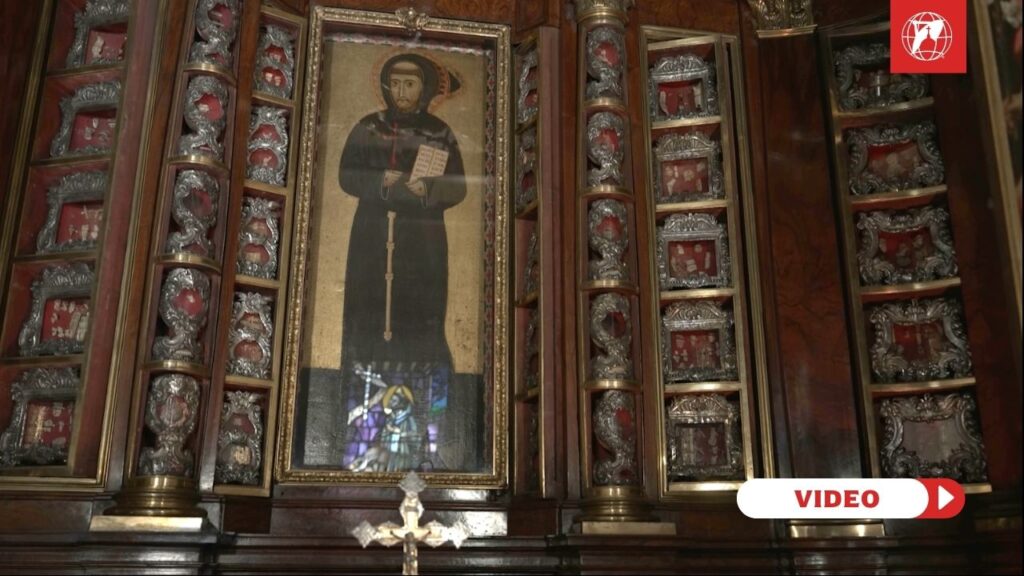
Nearby stands another remarkable object: an elaborate walnut-rootwood reliquary altar containing numerous relics of Franciscan saints.
The work also includes a mechanical system that has continued to be operated manually for centuries.
Together, these treasures make the sanctuary an extraordinary repository of Franciscan history in the center of Rome.
An Ancient Portrait of St. Francis
Another treasure is found inside the church: an early panel depicting St. Francis by the medieval painter Margaritone d’Arezzo.
The work dates to the 13th century, only a short time after Francis’ death in 1226.
That proximity is important.
According to Fr. Danilo, the features of Francis in the painting may have been influenced by descriptions provided by the saint’s earliest companions.
Margaritone may therefore have had access to friars who actually remembered what Francis looked like.
The painting presents a severe and unmistakably medieval Francis.
In one hand he carries a cross. In the other is a reference to Christ’s words in the Gospel:
“Whoever wishes to follow me must deny himself, take up his cross, and follow me.”
It is a fitting verse for the saint whose entire vocation centered on taking the Gospel seriously.
Francis did not simply want to admire Christ.
He wanted to imitate him.
A Franciscan Mission That Continues Today
San Francesco a Ripa could easily have become a monument devoted entirely to the past.
Instead, the friars have made it a place where Francis’ mission continues.
Since 2011, the Franciscan community has welcomed young men between the ages of 18 and 35 who were forced to leave their homelands because of war, poverty and other hardships.
The initiative, known as the Ripa Project, seeks to offer them the possibility of rebuilding their lives.
Today, 12 young men live inside the convent alongside the friars.
And this is not simply a matter of providing beds.
“They live with us, 24 hours a day,” Fr. Danilo explained. “They share meals with us and also other spaces.”
The friars and volunteers help the young men navigate the practical challenges of beginning a new life in Italy.
That can include obtaining permits and documents, learning Italian, receiving professional training and preparing to enter the workforce.
The project is built around accompaniment rather than distance.
The young men are not simply housed by the Franciscans.
They share their home.
The Same Mission, 800 Years Later
There is a striking continuity between what happened at this site in the 13th century and what happens there today.
When Francis arrived in Rome, he stayed at a hospice dedicated to welcoming pilgrims, the sick and those experiencing hardship.
More than 800 years later, the building remains a place of welcome.
The circumstances have changed.
The ancient port has disappeared. Medieval Rome has become a modern capital. The small brotherhood founded by Francis has spread around the world.
But the fundamental question remains the same:
How should a Christian respond to the person in need who arrives at the door?
For St. Francis, the answer was found in the Gospel.
His encounter with lepers had transformed his life because he learned to see something beyond sickness, poverty or social exclusion. He learned to recognize a brother.
That same idea lies at the heart of the Franciscan presence at Ripa today.
Following Francis in Rome
Rome contains some of Christianity’s greatest treasures.
Pilgrims can pray at the tombs of Sts. Peter and Paul, walk through ancient basilicas and encounter centuries of Christian art and history.
San Francesco a Ripa offers something quieter.
Here, pilgrims can enter the place where Francis is believed to have slept, see the stone associated with his stay and stand before an image painted within decades of his death.
Yet perhaps the most important Franciscan treasure at Ripa is not something preserved behind glass.
It is what happens inside the convent today.
The memory of St. Francis is being kept alive not only through relics, paintings and ancient rooms, but through a table shared with strangers and a home opened to those searching for a new beginning.
Eight centuries after Francis came to this corner of Trastevere, the friars are still welcoming people facing suffering and hardship.
The saint left Rome long ago.
But in San Francesco a Ripa, his footsteps have not disappeared.
They are still being followed.
Adapted by Jacob Stein. Produced by Bénédicte Cedergren; Camera by Fabio Gonnella.