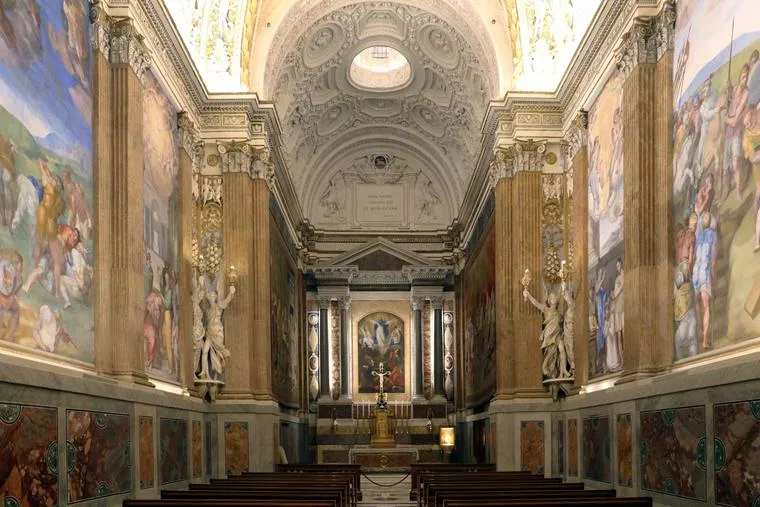
Rome’s celebration of the Jubilee of the Poor unfolded as a living reminder that the Church’s mission begins with encounter. In continuity with the 9th World Day of the Poor, established by Pope Francis in Misericordia et Misera, the Vatican hosted Mass with Pope Leo XIV and a shared lunch inside its walls. Across the city, one of the most moving gatherings took place in Trastevere, where the Community of Sant’Egidio welcomed 150 homeless people and struggling families into the Basilica of Santa Maria in Trastevere.
Paolo Stifano, who is a student serving Sant’Egidio, described their approach. “We talk with the poor and we say, on Sunday there will be this lunch, would you like to come? And if they say yes, we prepare a table for them.”
This spirit of hospitality brought together an unexpected mix of people — students, longtime volunteers, migrants, and even Rome’s newly appointed police commissioner, Roberto Masucci.
“Today we are here as volunteers; many of us belong to the State Police, and many have been awarded the Order of Merit of the Italian Republic, therefore by the President of the Republic. And our intention is to make ourselves available, to be close to people on this beautiful day in which we have given attention to those who are in need.”
For Masucci, serving the poor touches the heart of the police mission, too — a mission centered on human dignity. “I think the biggest challenge is people. We need to work on people, be close to people. Naturally, as police officers, we also have to intervene with enforcement when the law is violated. But we must never forget that we are dealing, above all, with people whom we must respect, and we should, as much as possible, put them in a position to change their path and take the right way.”
Around the tables, many of the volunteers, like Stifano, were young — high school and university students whose weekends could easily be spent elsewhere. For engineering student Andrea Salzano, volunteering was not only a commitment, but a change of perspective.
“Well, volunteering for Sant’Egidio has given me the chance and the possibility to help as many people as possible because in my private life I only could help like a few. But coming here made me help a lot of people… seeing the smiles of these people makes me the happiest man alive.”
Others came to Sant’Egidio hesitantly and found their hearts transformed over time. Stifano admitted that beginning this work was not easy. “When I started, it was kind of difficult to me. Why? Because, of course, I never had contact with the people in the streets. But then I started to talk with them. I started to know them. And I realized that we are the same… society likes to build walls between us and them, but in reality, it’s just us.”
He also added that “the only difference between me and the people who sleep on the street is that maybe I was just luckier because I had a family who helped me to study, to pay my rent for my house.”
Sant’Egidio’s care extends beyond meals. Their “Good Shepherd” project, originally launched for cold-weather emergencies, continues to provide shelter thanks to students and young adults who keep it running. One of the guests, Aylou Sow, a migrant from Senegal, expressed what this welcome has meant for him. “We are well welcomed and they make sure we are okay. We have things, opportunities—with them as well; they are helpful for us and we are helpful for them. They try to give us some peace of mind and also provide the things we need.”
For Sow, what matters most is the sense of dignity restored: “It’s important to behave like decent people, to behave well just as they do. They are all a source of peace and welcome, and there is also friendship between Italians, immigrants, and foreigners.”
At the heart of the celebration stood Fr. Marco Gnavi, parish priest of Santa Maria in Trastevere, who reflected on the deeper meaning of the day. “Within each one of them, there is a man, there is a woman with his wounds, his hope. And sometimes they do not need only food or clothes, but they need family.”
For him, charity is always inseparable from relationship:
“We have to touch their flesh and to realize that they need to be healed by friendship, by love. And every one of us is able to offer friendship and love.”
Adapted by Jacob Stein. Camera by Sergio Natoli; Special thanks & Credits to Sant’Egidio Community