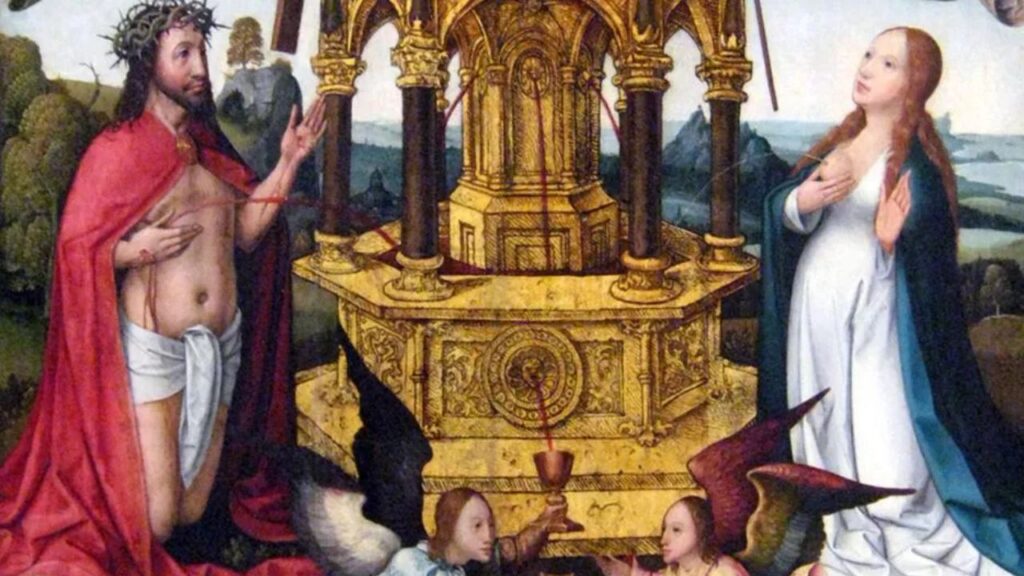
Among the Church’s many chants and hymns, the Pange Lingua (Tantum Ergo) holds a special place in Catholic devotion to the Real Presence of Christ in the Eucharist.
Traditionally sung during Benediction of the Blessed Sacrament, when the Eucharist is exposed for adoration, the hymn gives voice to the Church’s wonder before a mystery that surpasses human understanding. Its final two stanzas, commonly known as the Tantum Ergo, continue to accompany Eucharistic adoration and benediction in churches throughout the world.
The hymn is a prayer of adoration before the Holy Eucharist, a mystery so profound that it has stirred both faith and doubt across the centuries. One of the most important moments in the history of Eucharistic devotion began in the 13th century, with a priest struggling to believe.
The Miracle of Bolsena
Brother Alessandro Monti, OP, a Dominican friar at Santa Maria sopra Minerva, recalled the story of a Bohemian priest who traveled from Prague to Rome in 1263, seeking clarity about the Eucharistic mystery.
According to Brother Monti, the priest came “to pray a lot and ask the Lord to enlighten him about the Eucharistic mystery.” While in Rome, his doubts seemed to fade, but on his journey home, they returned. Stopping in Bolsena, a town in central Italy, he celebrated Mass at the local church.
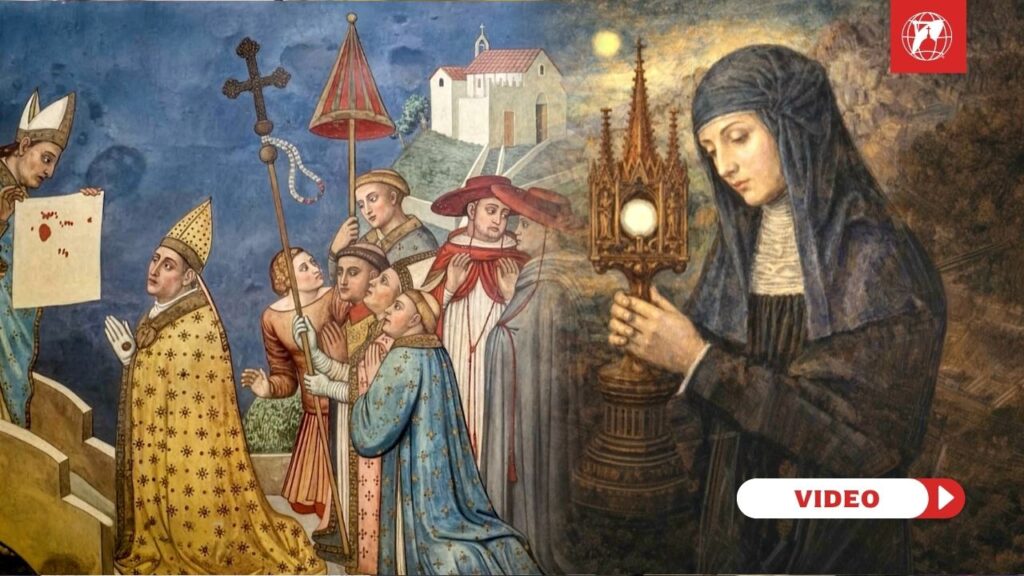
It was there, Brother Monti explained, that “while he was dealing with a consecrated host, he noticed that the host was dripping some stains of blood on the corporal,” the fine cloth used during Mass to hold the Eucharist. Shocked and afraid, the priest closed the corporal after Mass and brought news of what had happened to the Pope.
Providence had placed Pope Urban IV nearby in Orvieto, where he was residing for reasons of safety. When he heard of the miracle in Bolsena, the Pope recognized its significance, especially in light of an earlier encounter that had impressed upon him the importance of the feast of Corpus Christi.
Pope Urban IV and the Feast of Corpus Christi
Brother Monti explained that Pope Urban IV had personally known Saint Juliana of Cornillon, the Augustinian nun who helped spread devotion to Corpus Christi. At first, the feast was celebrated locally in the Diocese of Liège in Belgium, but Urban understood that the devotion had meaning for the whole Church.
In the Middle Ages, debates over the Eucharist were intense. Brother Monti noted that “there were fierce theological debates who wrongly applied philosophical categories to understand the Eucharistic nature of the Eucharistic mystery.” The Church recognized that reason, when used rightly, could help believers approach the mystery of God. But there was also a danger that a misuse of reason could distort the truth of the faith.
For that reason, he said, Corpus Christi was not merely “a matter of popular piety and devotion in a single region as Belgium, it really mattered to the whole Christian world.”
After confirming the authenticity of the miracle of Bolsena, Pope Urban IV called upon two of the greatest theologians of the age, Saint Thomas Aquinas and Saint Bonaventure, to compose the liturgical office for the feast.
Saint Thomas Aquinas and the Birth of the Pange Lingua
According to tradition, the choice of who would compose the office was marked by a sign of divine inspiration.
Brother Monti recounted that when Saint Bonaventure entered the room where Saint Thomas Aquinas was composing his hymn, “he saw a dove who was dictating the words and presumably the melody to Saint Thomas Aquinas.” The dove, he explained, was understood as “a sort of symbol of the Holy Spirit.”
Recognizing this sign, Saint Bonaventure chose not to present his own composition to the Pope, but instead “gave the floor, so to speak, to Saint Thomas Aquinas,” who was then selected to compose the liturgical office for Corpus Christi.
It was in this context that the Pange Lingua was born. Through the theological depth and poetic genius of Saint Thomas Aquinas, the hymn became one of the Church’s most enduring expressions of Eucharistic faith.
Faith Beyond the Senses
The Pange Lingua continues to draw Catholics into the mystery of Christ’s presence in the Eucharist because it unites poetry, theology, and adoration.
Brother Monti said he is struck by the way Saint Thomas “praises the Blessed Sacrament in a very poetical way,” while remaining deeply attentive to “the speculative dimension of the mystery.” Aquinas understood that human senses alone are not enough to perceive the Body and Blood of Christ. Yet, as Brother Monti explained, “the Lord can help us to see invisible things by virtue of supernatural faith.”
In this way, the hymn reflects both the natural order of human knowledge and the supernatural gift of faith. It teaches that while Catholics begin with what they can see, taste, and touch, the Eucharist calls them beyond the senses into the mystery of Christ’s real presence.
Centuries after the miracle of Bolsena and the institution of Corpus Christi for the universal Church, the Pange Lingua remains a living prayer. Sung before the Blessed Sacrament, it continues to invite the faithful to adore Christ hidden under the appearances of bread and wine, and to enter more deeply into the mystery at the heart of the Catholic faith.
Adapted by Jacob Stein.