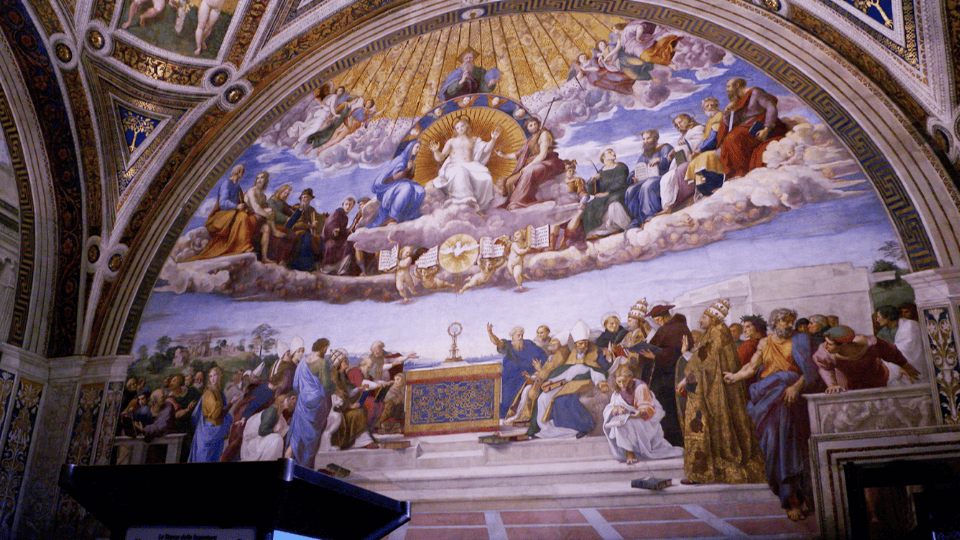
Pope Francis notes, “The Church has always had a relationship with artists that can be described as both natural and special.”
The Jubilee of Artists and World of Culture kicked off with an international conference at the Vatican Museums to discuss the transmission of religious and artistic heritage.
The director of London’s National Gallery, Gabriele Finaldi emphasised the transcendent power of art:
“The encounter with art and beauty,” he said, “is always in some sense an encounter with that, which is numinous with that, which is beyond. And so, the church in particular has been very skillful in making use of the arts, to make more profound, the religious experience.”
Finaldi underlined the importance of teaching appreciation for beauty to future generations.
He shared, “I think that art and beauty can speak across time, they can speak across different human experiences and so it’s very important, particularly with young people that we give them the opportunity and try develop a sensibility.”
Over the Jubilee weekend the doors of the Lateran Palace opened up to the public for a variety of performances by students from different art schools across Rome.
Father Gabriele Vecchione, assistant pastor at Our Lady of Lourdes parish in Rome, works closely with the youth and encourages them to use their talents to glorify God.
“To glorify God,” he noted, “you simply have to be truthful, in the sense that St. Thomas Aquinas said that wherever there is the first material, whether it’s painting, music, drama, acting, it is already glorifying God, sometimes unconsciously, sometimes implicitly, sometimes explicitly. I think that wherever there is this love for the truth, God is already being spoken of. And how can we use performance to glorify God?”
Artists from all around the world travelled to showcase their artwork and connect with other like-minded people.
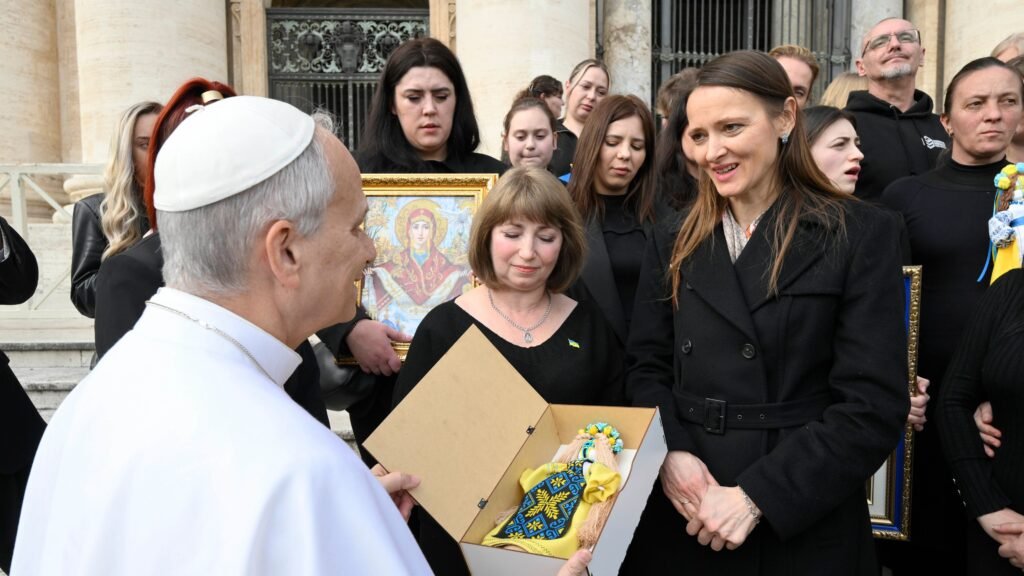
Pope Francis met with Nikas Safronov, one of Russia’s most beloved contemporary artists. Safronov gifted a personal painting to the Holy Father and shared that it deeply moved the Pope.
He explained, “I was in Buenos Aires on a creative business trip, I had a client there. And when I flew there, I found out that Pope Francis had started his priestly ministry in this church. And I took a photo and then sketched it. When I came back to Moscow, I painted it. This was around 2020.”
Safronov will be returning home with deep inspiration drawn from his time in the Eternal City.
“You know, before this interview today,” he shared, “I was walking through Rome on foot, stopping in every church along the way. It made me think about how even in Russia, we lack churches like these—so many were destroyed during the Soviet era, and that was a tremendous loss.”
“You can truly feel the spirituality that fills you,” he added. “It enriches my creative work, and every time I return from Italy, I feel an incredible surge of strength. I do a lot of sketches here, and later, they become part of an entire series.”
A few selected artists have been given a small room near the Vatican as a space to exhibit their artwork throughout this Jubilee Year.
The first artist to do so is Chinese-born French painter, Yan Pei Ming, who reflected on hope in his 27 portraits of prisoners and staff at the Regina Coeli prison.
Pei-Ming said, “I believe the theme was given by Pope Francis, who is very attuned to the idea of hope. When you are in prison, you have to prepare for the day you will eventually be released. So, I think this is a universal theme.
“In this exhibition,” he explained further, “you cannot go inside. People view the exhibition from the outside— it’s like a prison. There are 27 people crowded into a small space, which is already symbolic.”
“When you visit exhibitions and museums around the world, it always starts with ancient paintings connected to the church,” Pei-Ming added. “So, it’s the foundation of another civilization. For example, when you see the Louvre in Paris or the Uffizi in Florence, it starts there. Artists, in the past, lived thanks to the Church.”
Art and spirituality have long shared a powerful connection, with artists using their work to explore and challenge our beliefs. From religious icons to modern expressions, art invites us to reflect on the divine and our place in the world.
Adapted by Jacob Stein