VATICAN CITY — From academic conferences and university discussions to interfaith prayer gatherings and colorful cultural performances, people of all ages, nations, and faiths came together in Rome to celebrate the 60th anniversary of Nostra Aetate — Pope Paul VI’s 1965 declaration on the Church’s relations with non-Christian religions.
The Eternal City became a living symbol of dialogue and unity, as choirs, scholars, and world leaders joined in marking this milestone of interreligious friendship.
Pope Leo XIV brought the celebrations to a close in St. Peter’s Square, where he welcomed thousands of pilgrims and called for a renewed spirit of cooperation and peace.
“Today we are called upon to rekindle that hope in our world, devastated by war and our degraded natural environment,” Pope Leo said during his General Audience on October 29. “Let us collaborate, because if we are united, everything is possible. Let us ensure that nothing divides us. And in this spirit, I would like to express once more my gratitude for your presence and your friendship. Let us transmit this spirit of friendship and collaboration to the future generation too, because it is the true pillar on which dialogue rests.”
Rediscovering the Vision of Nostra Aetate
In keeping with the Church’s commitment to dialogue, the Pontifical Gregorian University hosted a three-day international conference, supported by the Dicastery for Interreligious Dialogue and the Commission for Religious Relations with the Jews.
The event brought together scholars and theologians to explore the continuing relevance of Nostra Aetate — and to reflect on its message in an age often marked by division.
Professor Ambrogio Bongiovanni, Director of the Center for Interreligious Studies at the Gregorian University, said that revisiting Nostra Aetate helps remind society of the need to build bridges rather than barriers.
“Now we are living in a situation in the world where we have somehow developed a kind of negative approach to ‘otherness,’” he explained. “You know, building walls instead of bridges. So I will say that rethinking Nostra Aetate supports the idea of building bridges among people, among differences.”
Acknowledging the Past, Building the Future
Professor Massimo Gargiulo, Director of the Cardinal Bea Centre for Judaic Studies, emphasized that understanding Nostra Aetate requires returning to its origins — the dialogue between Cardinal Augustin Bea and Jewish historian Jules Isaac.
“The first important thing of this document is that it recognizes what is historically true, that is that the origins of Christianity are rooted into Judaism, for the reason that Jesus was a Jew, that Paul was a Jew, and so on. So the first thing is this acknowledgement,” Gargiulo said.
He added that the document also represents the Church’s moral reckoning. “The second one is that the Church recognized its responsibilities toward the Jews for their history, from the ancient times until World War II and the Holocaust, because it recognized the bad results, the tragic results, of Christian anti-Judaism …”
A Global Gathering for Dialogue
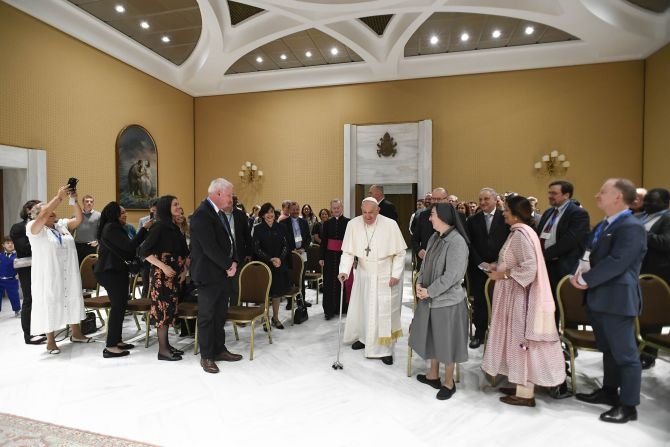
The conference brought together 300 participants from 44 countries, representing 14 world religions — including Jainism, Sikhism, Buddhism, and Islam. Many later attended the Vatican event “Walking Together in Hope” on October 28, where Pope Leo XIV addressed the group inside the Paul VI Audience Hall.
“This is the journey that Nostra Aetate invites us to continue — to walk together in hope,” the Pope told them. “Then, when we do so, something beautiful happens: hearts open, bridges are built and new paths appear where none seemed possible. This is not the work of one religion, one nation, or even one generation. It is a sacred task for all humanity — to keep hope alive, to keep dialogue alive and to keep love alive in the heart of the world.”
Praying for Peace at the Colosseum
Earlier that same day, Pope Leo XIV joined religious leaders at the Colosseum for the International Meeting for Peace, organized by the Community of Sant’Egidio. Together, they prayed for an end to war and called on governments to take real action for peace.
“God will ask an accounting of those who failed to seek peace, or who fomented tensions and conflicts,” Pope Leo said. “He will call them to account for all the days, months and years of war. As religious leaders, this is the heartfelt appeal that we make to those in positions of government. We share the desire for peace for all peoples. We are the voice of those who are not heard and the voiceless. We must ‘dare peace’! Even if the world turns a deaf ear to this appeal, we are certain that God will hear our prayer and the cries of so many who suffer. God wants a world without war. He will free us from this evil!”
A Living Legacy
Sixty years after its publication, Nostra Aetate continues to shape the Catholic Church’s mission of dialogue and peace. Its message — that all humanity is bound together in the search for truth and understanding — remains as relevant today as it was in 1965.
In Rome, that message came alive once again, as people of faith “walked together in hope,” proving that the path opened by Nostra Aetate still leads toward unity, reconciliation, and love.
Adapted by Jacob Stein. Camera by Sergio Natoli