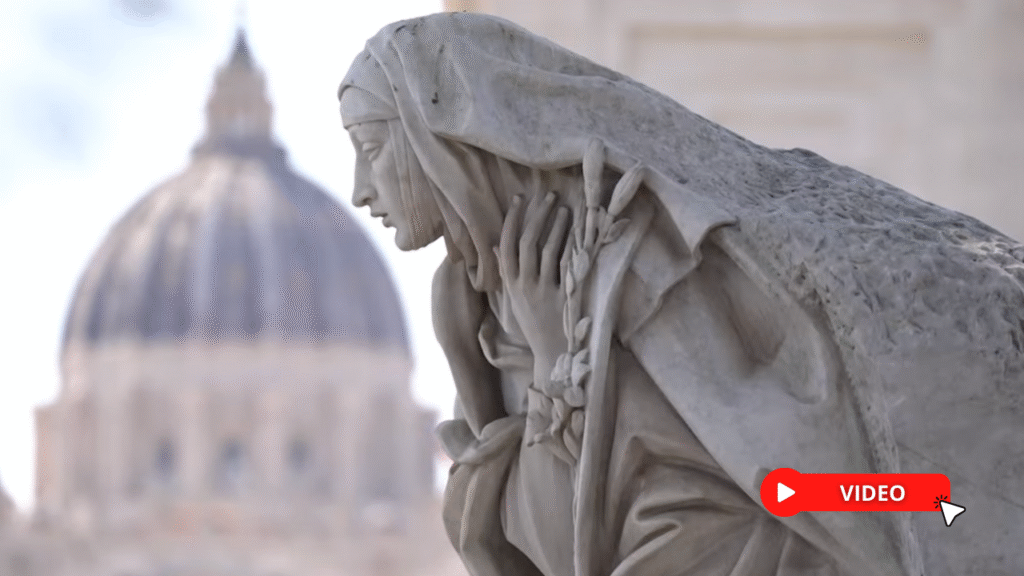
In Piazza Pia, just steps from St. Peter’s Square, a statue quietly points the way forward. It is St. Catherine of Siena—a woman of extraordinary spirituality, courage, and civic engagement, and one of the few women proclaimed a Doctor of the Church. Her presence there is no accident. It reflects a life spent guiding the Church at one of the most turbulent moments in its history.
Born in Siena in 1347, Caterina Benincasa emerged as one of the most remarkable figures of the Middle Ages. From an early age, she displayed an intense spiritual sensitivity, nourished by profound mystical experiences. Father Alessandro Monti, a friar at Santa Maria sopra Minerva, recounts her first vision of Christ.
“The first of them occurred when she was around four to five years of age,” Fr. Monti explained, “and in this vision, Christ himself appeared to her dressed as a Pope, and he was with Saint Peter and Saint Paul.”
From that moment, he said, Catherine grasped “the importance of this intimate relationship between Christ and the church, between Christ and the papacy.”
A Mystic in the Midst of Crisis
Catherine’s spirituality was never detached from the world around her. Sister Catherine Droste, professor of theology at the Angelicum, situates her life within the profound crises of her time.
“She was born in a period of crisis,” Sr. Droste noted. “The plague had just arrived in Europe, and it arrived in Siena, actually, just a year after she was born.”
Another crisis defined Catherine’s entire life: the Avignon Papacy, during which the popes lived outside Rome for decades. “She spent many years of her life trying to encourage the Pope to return to Rome,” Sr. Droste said, “because this was where Peter and Paul lived, and the Pope needed to be here in Rome.”
Despite lacking formal education, Catherine became a tireless letter-writer, addressing nobles, merchants, clergy—and above all, Pope Gregory XI. Fr. Monti describes the challenge she faced in advising a hesitant pontiff.
“Gregory XI was a bit of a Hamlet in the Vatican,” he said. “He was really undecided, full of doubts, hesitant.”
Catherine, he explained, responded with courage. “With him, she had to play the part of the strong counselor who really empowers the pope and says, don’t be afraid, be bold, be ambitious.”
Her persistence bore fruit. In 1377, Catherine succeeded in convincing Pope Gregory XI to return the papal seat to Rome, ending nearly seventy years of exile—a decision that reshaped the course of Church history.
Love Made Flesh: Mysticism, Sacrifice, and Legacy
As Catherine’s public mission unfolded, her interior life deepened into a constant dialogue with Christ. From one of her mystical experiences emerged The Dialogue of Divine Providence, her theological masterpiece. Fr. Monti describes the way this work came to life.
“It was kind of intuition, intellectual intuition that she had,” he said, “as if Christ himself taught her the doctrines that are included in the dialogue.”
At the heart of her theology, he explained, is Christ as the bridge between heaven and earth. “Christ himself is a bridge that allows us to reconnect with heavens.”
Catherine’s bond with Christ took the form of a mystical marriage. In Pisa, she received the stigmata, which remained invisible at her request. Fr. Monti describes this intimate union.
“It’s a shared secret, so to speak, between her and her spouse,” he said. “When you are one with your spouse, you share everything… And she shared them also in her own body.”
Today, at Santa Maria del Rosario on Monte Mario, a relic preserves this extraordinary legacy: the small hand of St. Catherine of Siena. Sister Domenica De Marco, Mother Prioress of the Dominican Monastery there, reflects on its meaning.
“It’s impressive to see that such a great saint had such a small hand,” she said, “yet it was capable of moving the Pope.”
Catherine died at the age of 33, exhausted by fasting, prayer, and penance. Alessandra Bartolomei Romagnoli, professor at the Pontifical Gregorian University, explains the spiritual meaning of her sacrifice.
“Giving herself completely—making that sacrifice—was, for her, the greatest sign of love,” she said. “God became human so that humans could become like God.”
Catherine died in Rome, and her remains rest beneath the altar of Santa Maria sopra Minerva. Hidden within the sacristy is the ‘Catherine Room,’ reconstructed in 1637 from the original walls of the chamber where she died. Fr. Monti explains a striking architectural detail.
“There is this little hole in the ceiling,” he said, “and there is a fresco representing the dove… coming from heaven to earth to call Catherine.”
Outside, in Piazza Pia, Catherine’s statue faces the bridge leading toward Via della Conciliazione and St. Peter’s Basilica. For Sr. Droste, the symbolism is unmistakable.
“If you stand where Catherine is, she’s looking at a bridge,” she said. “Because the bridge for Catherine was Christ.”
That bridge, she added, remains open. “Christ is still trying to save us… And we need to cross that bridge.”
From a small hand to a towering legacy, St. Catherine of Siena continues to point the way—toward Christ, the Church, and the courage to act when history demands it.
Adapted by Jacob Stein