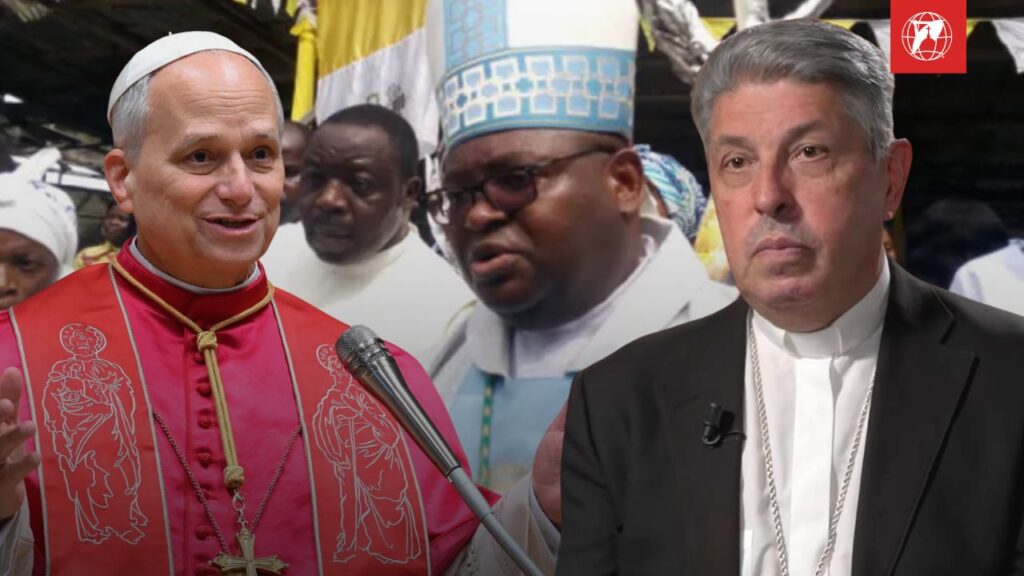
As Pope Leo XIV prepares for his first apostolic journey to Africa, the Apostolic Nuncio to Cameroon and Equatorial Guinea describes a Church that is youthful, vibrant, and deeply engaged in the life of society, even amid significant challenges. In an interview ahead of the papal trip, the Nuncio reflected on the vitality of the Catholic faith in the region and the hopes surrounding the Holy Father’s visit.
A Lively Church Across Diverse Lands
Cameroon is a country of striking diversity, stretching from the Atlantic coast to the Sahel. It includes tropical rainforest, desert regions, and abundant coastal areas. It is also fully bilingual, with both Anglophone and Francophone regions.
Within this varied landscape, the Catholic Church is flourishing. The Nuncio noted that he frequently celebrates Mass for large congregations, including one recent liturgy attended by 8,000 faithful. Celebrations are joyful and vibrant, often lasting several hours and filled with music and active participation. For many Catholics, Sunday Mass is the central event of the week.
Equatorial Guinea, the only Spanish-speaking country in Africa, has nearly two million inhabitants and is approximately 95 percent Catholic. The country has experienced infrastructure growth in recent years due to petroleum exportation.
Education, Healthcare, and Social Outreach
The Church plays a central role in education and healthcare in both countries. According to the Nuncio, Catholic institutions operate extensive networks of schools and clinics and are often present where other institutions are not.
A Catholic regional pontifical university serves several Central African countries, with faculties located across the region.
More than 300 religious congregations are active in Cameroon, each engaged in pastoral, educational, healthcare, or social outreach initiatives. Among them are homes that offer support to minors leaving prison after minor infractions, day centers welcoming children who arrive in cities seeking work, and orphanages that provide education and long-term formation. Many young people who receive assistance later return as professionals to support the institutions that helped them.
Challenges and the Work of Peace
The Church’s mission unfolds amid serious challenges.
In Cameroon’s Anglophone regions — comprising five dioceses and approximately six million people — violence linked to separatist tensions has persisted for eight to nine years. In the Far North, Boko Haram remains a threat. In the eastern region, roughly one million refugees from Chad and the Central African Republic are present.
The Church is actively engaged in humanitarian and reconciliation efforts. The Jesuit Refugee Service and the Diocese of Maroua-Mokolo are particularly involved in assisting displaced persons. International aid, especially from Europe and North America, has supported these efforts.
The president of the bishops’ conference, Archbishop Andrew Nkea, has worked to bring different parties together in dialogue. The Nuncio emphasized that peace requires cooperation among civil, religious, and educational institutions and must be cultivated intentionally.
He also described an initiative at the Apostolic Nunciature featuring photographs of children holding a traditional peace plant. Asked what peace means to them, children between the ages of seven and fifteen responded simply: being able to go to school without violence, to sleep safely at night, and to live in mutual love. Children, he noted, are often the first victims of conflict.
Why Africa?
Reflecting on why Pope Leo XIV chose Cameroon and Equatorial Guinea for one of his first apostolic journeys, the Nuncio pointed to the Holy Father’s Augustinian identity. St. Augustine, one of the Church’s great Doctors, was African. As a member of the Augustinian order, Pope Leo may see in this visit a spiritual connection to that heritage.
The visit also represents recognition of Africa’s vitality in the life of the universal Church.
Cameroon, in particular, has strong priestly and religious vocations. No seminary has fewer than 100 seminarians, and some host between 150 and 250. Preparatory institutions also serve hundreds of young men. Despite limited resources, these institutions provide solid formation.
A Young Church at the Heart of the Faith
With an average age of 18, Cameroon is a youthful nation. The Nuncio observed that Catholics there do not see themselves as a “periphery,” but as fully alive within the Church.
He recalled a period in Cameroon’s history when clergy were not permitted in the country for several years. During that time, lay catechists safeguarded parish life, maintained registers, and prepared the faithful for the sacraments until priests could return. This experience remains a powerful example of co-responsibility between clergy and laity.
A History of Papal Visits
Cameroon has previously welcomed St. John Paul II in 1985 and 1995, and Pope Benedict XVI in 2009. In 1995, St. John Paul II signed the apostolic exhortation Ecclesia in Africa in Yaoundé. Each visit came during moments of national difficulty and left a lasting spiritual impact.
The upcoming visit of Pope Leo XIV is expected to draw millions.
A Visit of Hope
The Nuncio expressed hope that the Holy Father’s presence will strengthen peace efforts, reinforce interreligious dialogue — particularly with Muslim communities — and offer encouragement to young people facing questions of governance and corruption.
The Pope’s first words after his election — “Peace be with you” — are expected to resonate deeply.
As preparations continue, the Church in Cameroon and Equatorial Guinea awaits the Holy Father with expectation, confident that this visit will bring renewed encouragement to a faithful people already deeply committed to living the Gospel.