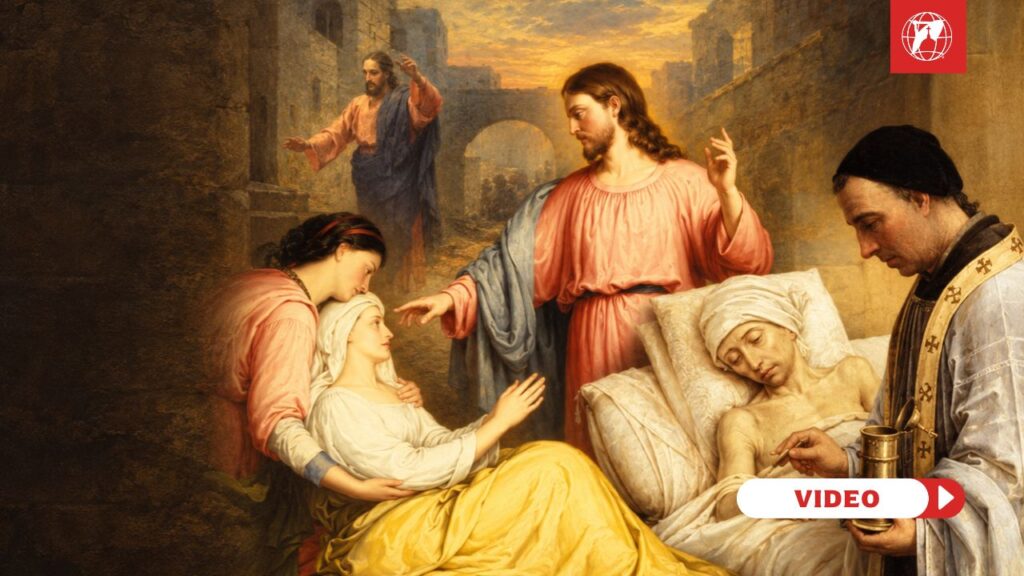
For many Catholics, the Anointing of the Sick is associated primarily with the final moments of life. Yet the Church teaches that this sacrament is not reserved for those who are dying. It is intended for the faithful facing serious illness, the difficulties of old age, or the challenges that come with a significant decline in health.
Rooted in the healing ministry of Jesus Christ and the teachings of Sacred Scripture, the Anointing of the Sick is a sign of God’s closeness to those who suffer. It offers spiritual strength, forgiveness, and grace at a moment when people may feel particularly vulnerable.
Speaking with EWTN News, Fr. Pierre Kabongo, chaplain at Sant’Eugenio Hospital in Rome, explains the origins of the sacrament, how it is administered, and how accompanying the sick can open the door to renewed faith and reconciliation.
A Sacrament Rooted in the Healing Ministry of Jesus
The origins of the Anointing of the Sick can be found in the life and ministry of Jesus, who consistently approached those suffering from illness with compassion.
Asked where the sacrament comes from, Fr. Kabongo points first to Christ’s willingness to share in the human condition and to care for those in need.
“The Anointing of the Sick comes from the very experience of Jesus Christ, God made man, who came to dwell among us and to share in the human condition, which includes illness. Jesus teaches through His life. He never turned away when He encountered someone in difficulty or someone who was sick.
From this alone, we can already understand that the Anointing of the Sick, in Christ’s perspective, is a sacrament of God’s closeness to those who suffer.”
The sacrament is also grounded in Sacred Scripture, particularly in the Letter of St. James, which instructs the faithful to call the elders of the Church to pray over those who are sick.
Fr. Kabongo explains that this prayer is directed not only toward physical healing, but also toward the spiritual well-being of the person receiving the sacrament.
“The second source of the Anointing of the Sick is Sacred Scripture. Through the Apostle James, Sacred Scripture teaches us that he urged the faithful, saying: “If any of you is sick and suffering, call for the presbyters, that is, the elders of the Church, “and let them pray over him.” Such prayer, offered in faith, can help the sick person not only recover from illness, but above all lift the eyes of both heart and body toward the One who is not only the physician of the body, but also the physician of the soul.”
Bringing the Sacrament to the Sick
As a hospital chaplain at Sant’Eugenio Hospital in Rome, Fr. Kabongo regularly accompanies patients and their families through moments of illness, uncertainty, and suffering.
He says requests for the Anointing of the Sick remain frequent, even in a society where many people are no longer closely connected to the Church.
“Very often, extremely often. Even though today’s society is not entirely Catholic or Christian. On a very consistent and regular basis, there are always one or two requests, sometimes even three a day, for the Anointing of the Sick.”
For Fr. Kabongo, administering the sacrament begins with being present to the person who is suffering. It is not simply a ritual performed at a bedside, but an encounter that involves listening, prayer, and the Church’s ministry of mercy.
He identifies three essential elements in its administration: accompanying the sick person, praying together, and anointing with the Oil of the Sick.
“There are three essential things that happen in the administration of the sacrament. The first is contact with the suffering person, that sharing in the person’s situation which led him, her, or the family to request the sacrament. The second element is the prayer itself, which begins with the penitential act. Together, we ask God for forgiveness of our sins and receive His absolution, His mercy, and His forgiveness.”
The priest then lays hands on the person receiving the sacrament and prays for God’s grace. Following the reading of the Word of God and the penitential prayer, the priest anoints the sick person with the blessed oil.
Fr. Kabongo also describes the possibility of granting a plenary indulgence in the circumstances and under the conditions established by the Church. When a person is approaching death, the priest may additionally administer Viaticum — Holy Communion given as spiritual nourishment for the final journey.
“Then the priest, by the faculty granted to him by the Holy See, lays hands on the suffering person to grant what is called a plenary indulgence, that is, the complete and total remission of all sins. Only after hearing the Word of God, after asking for forgiveness, and after receiving that forgiveness, can one proceed to the anointing itself with the Oil of the Sick.
Then, at the end, when possible, the priest may also give the Viaticum ., that is, Holy Communion for someone who is at the point of death.”
When Illness Becomes an Opportunity for Reconciliation
Beyond the physical and emotional challenges of illness, a hospital chaplain often witnesses how a serious diagnosis can bring families together and lead people to rediscover their faith.
Fr. Kabongo has encountered patients who had been distant from the Church for many years but began praying again when faced with serious illness or the possibility of death.
He recalls how these moments can become opportunities for reconciliation, both within families and between individuals and God.
“Many times I have seen families who were divided come together around a sick family member. I have also often found myself beside someone whose relatives say, “You know, he was far from the Church all his life. He never went to Mass and had given up prayer.” Yet that person suddenly begins to pray with you: “Our Father, who art in heaven, hallowed be Thy name…” It is a beautiful thing, a truly beautiful thing, because it opens a door for that living person to contemplate the perspective of eternity in God, who is our source and also our final destination.”
These experiences reveal another dimension of the sacrament: the opportunity to turn toward God, receive His mercy, and prepare spiritually for the encounter with Him.
Preparing for the Journey Home
The Anointing of the Sick is not simply a sacrament for the final hours of life. It is an expression of the Church’s care for those who suffer and a reminder that no one faces illness alone.
Through the sacrament, the faithful are invited to entrust themselves to Christ, who shares in human suffering and offers the promise of eternal life.
Reflecting on his ministry, Fr. Kabongo expresses the hope that all people may one day experience the fullness of God’s embrace.
“My hope for all of us is that, on the day we find ourselves together at the feet of our Lord, who died for us and saved us from sickness and sin, when we stand before God in the fullness of eternal life, that His embrace may be not only warm but profound and everlasting; that our joy may be perfect and that life may be without end.”
For Catholics, the sacrament is ultimately a sign of hope: a reminder that God’s mercy accompanies the faithful through suffering, illness, and the final passage from this life to the next.
Adapted by Jacob Stein. Produced by Bénédicte Cedergren; Camera by Alberto Basile; Video Edited by Andrea Manna.