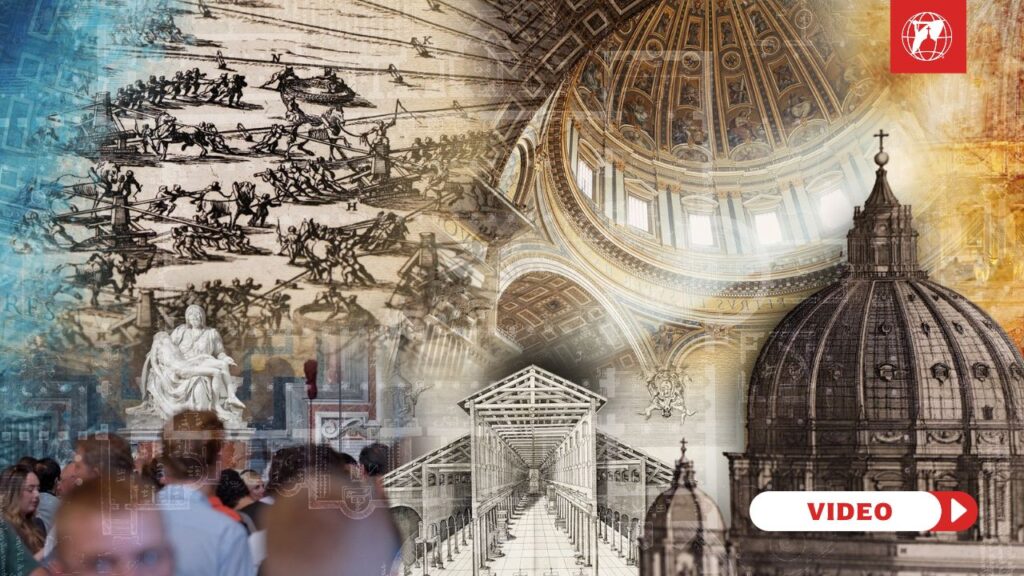
Vaticano Special · History, Art and Faith
Beneath Michelangelo’s dome and Bernini’s bronze baldachin, the history of St. Peter’s Basilica returns to a single place: the burial site of a fisherman from Galilee. Around that tomb, generations built a church whose story reaches from the persecutions of ancient Rome to the pilgrims arriving today.
November 18, 2026, marks the 400th anniversary of the consecration of the new St. Peter’s Basilica. In this Vaticano special, historians, an archivist, and a cultural heritage specialist explore the people and decisions that transformed a martyr’s grave into one of Christianity’s greatest places of worship.
Watch on YouTube
The tomb beneath the basilica
The scale of St. Peter’s can make its beginnings difficult to imagine. Long before the marble pavement, the towering piers, and the great dome, this was a place of burial. Understanding the basilica begins with the relationship between that modest origin and everything built above it.
“Beneath the baldachin and the dome, 2000 years of history and devotion converge in a single spot. Why here? Because it was here that St. Peter suffered martyrdom alongside the first martyrs in A.D. 64, during the persecution of Emperor Nero, and here that he was laid to rest.”
Rome was then the center of an empire in which Christians could face execution. The special places Peter’s martyrdom in the setting of Nero’s circus, where public entertainment and public punishment occupied the same arena.
“Nero had a circus, not clowns and animals, but a racetrack where they would do chariot races. It was entertainment. And sort of during halftime, they would do the public executions. […] Peter would have been crucified upside down, according to tradition, and then his body taken and buried at the closest place.”
The tradition of Peter’s upside-down crucifixion belongs to the Christian memory of his death. The veneration of his burial place explains why this particular location became so important to the community that followed.
“Above that burial site, a humble grave dug into the earth, a small funerary shrine was built […] around A.D. 160-170.”
That small shrine stands near the beginning of a much longer architectural history. The buildings changed, but the place they honored remained the organizing center of the sanctuary.
“These buildings symbolize a relationship, a physical spatial relationship with the early Church and through all of the history of the church.”
Constantine’s basilica and the decision to rebuild
In the fourth century, the end of persecution and the patronage of Emperor Constantine changed the public position of Christianity. Over Peter’s tomb, a monumental church gave architectural expression to that transformation.
“The first basilica comes only after the end of the persecutions. In the fourth century, Constantine orders it built over the tomb of St. Peter.”
The persecuted Apostle’s resting place now stood within an imperial foundation. Its spacious interior also served a practical purpose: receiving those who came to pray. Zander connects the size of the old basilica with a vocation that remains recognizable in St. Peter’s today.
“It was a magnificent building. Just imagine: a basilica divided into five naves by 88 columns, […] The old St. Peter’s was built large, immensely large, and it was built that way because of an innate vocation to welcome people. These basilicas were built so large because they were meant to welcome so many people coming from all over the world.”
“It was a basilica that had stood for many centuries, from its construction to the new St. Peter’s basilica, just think, 1,200 years.”
Across those centuries, the basilica experienced the changing fortunes of Rome. The papacy’s move to Avignon in 1309 formed part of a difficult period for the city. Later efforts to renew Rome would bring the condition and future of St. Peter’s into sharper focus.
“After the Avignon Papacy, which was about 70 years where the bishops of Rome, where the popes were in Avignon in France, Rome goes through a period of real decay. There’s not much population here. A lot of the buildings are abandoned […] So we come to the papacy of Nicholas V in the middle of the 15th century. […] His idea is to rebuild Rome to its ancient splendor as a way of reestablishing it as the capital of the church.”
The decisive commitment to a new basilica came under Julius II, who entrusted the project to Donato Bramante. Building again around the Apostle’s tomb required dismantling the church that had protected it for centuries.
“The project was simply too ambitious, too difficult, and its outcome too uncertain. Time passed, and we arrive to the beginning of the 16th century and Pope Julius II della Rovere, […] and he entrusted the project to the architect Donato Bramante. Remarkably, Bramante would go down in history not so much as the architect who began the new St. Peter’s, but as the architect who demolished the old one. Why? Because in order to build the new St. Peter’s over the tomb of the Apostle, the old basilica first had to be torn down.”
A great construction project, preserved on paper
Construction of the present basilica began in 1506. The undertaking would outlast individual popes and architects, bringing together successive generations of workers.
“Construction of the new basilica began in 1506, when Pope Julius II launched the largest construction project in history, for which countless craftsmen and workers were employed.”
The Fabbrica di San Pietro oversaw the building enterprise. Its Historical Archives preserve the documentation that makes the project visible in detail, from architectural ambitions to the cost of materials and labor.
“These are the archives that preserve the historical memory of this basilica, and they do so with extraordinary precision and detail, because it is, above all, an administrative and accounting archive, where virtually every expense incurred during the reconstruction of the basilica was recorded. How much was spent on the various materials? On lime, pozzolana, and travertine? How much was spent on all the craftsmen and workers employed in the reconstruction? And on all the great artists who wanted to take part in this magnificent enterprise?”
From a Greek cross to a Latin cross
Drawings trace the evolution of the design. The basilica took shape through successive decisions about how to organize its central space and accommodate its functions. Turriziani explains the change through the contrast between a Greek-cross plan and the extended Latin-cross form.
“Bramante, followed later by Michelangelo, began to work on a new structure based on a Greek-cross plan, rather than the Latin-cross layout of the ancient basilica. […] Bramante and Michelangelo stopped here. Then came Maderno in the early years of the 17th century, and he decided that the basilica should be built in the shape of a Latin cross. He therefore extended the entire structure, creating the basilica as we know it today.”
The documents also follow the dome’s progress. Michelangelo died in 1564 with construction at the drum; Giacomo della Porta and Domenico Fontana subsequently brought the great vault to completion in 1590.
“Here we can see the basilica taking shape, as well as the drum of the dome built by Michelangelo Buonarroti. […] This is an image of the basilica’s façade, with its two smaller side domes and the great central dome. Michelangelo succeeds in completing the drum, but then he dies in 1564 […]”
Michelangelo’s celebration for the workers
Financial records and drawings also open a window onto human relationships. Turriziani recounts a celebration organized by Michelangelo in 1550, with a meal for the workers and small caps to protect them from the sun.
“In 1550, among many other things, Michelangelo organized a splendid celebration on the roof of St. Peter’s main nave, where he had tables set up and the tables laid out, called for a cook, and treated everyone who had completed the main nave of St. Peter’s to a meal. And not only that, but he not only celebrated with them, he also gave each of them a small cap to wear to protect themselves from the sun.”
Such episodes restore the people behind the monument. The building required artistic vision, but also daily work, organization, and practical care for those carrying out the task.
The old basilica within the new
Rebuilding changed the architecture while preserving important connections with what had stood before. Art historian Elizabeth Lev describes the present basilica as a structure protecting older memories.
“The basilica that we see today, the basilica that we are celebrating this great anniversary, is like a protective shell around those ancient memories.”
“Down into the crypt, you can already see a few little hints: the original Constantinian twisting columns are placed up into the piers. There’ll be a monument or two that’s left over from the original church. […] In the crypt you’re on the floor level of Constantine’s old basilica, and you can see the markers of where the external wall was, or some stumps of a column or some pieces of the of the original basilica.”
These surviving elements encourage a different way of looking. The basilica can be understood vertically as well as horizontally: the visitor’s route through the present church passes above and among traces of earlier structures.
The porphyry disk and Charlemagne
One reminder lies underfoot. A red porphyry disk connects the visitor’s experience with the imperial history of the old basilica and Charlemagne’s coronation on Christmas Day in the year 800.
“That porphyry disk, it’s a very, very special stone that since antiquity was associated with emperors, and that disc was the disc upon which Charlemagne knelt. So on Christmas Day 800, so over a thousand years ago, he knelt on that disc, and he was crowned by the Pope […]”
The disk brings the encounter between papal and imperial authority into the material history of the church. Objects carried forward from the old basilica allow that history to remain part of the new building’s daily life. They can be passed without notice, yet they connect the present visitor with events many centuries removed.
Michelangelo: the Pietà and the dome
St. Peter’s holds two especially powerful encounters with Michelangelo: the Pietà, made when he was a young sculptor, and the dome that occupied his later years. Lev sees them as the beginning and culmination of a career gathered within one building.
“He takes over the job. And he did it very famously for no money. He did it for, and I quote, ‘the glory of God, the honor of Saint Peter and the salvation of my own soul.’ […] the funny thing about Saint Peter’s is you see the Pieta, which is his first public work, and the dome of Saint Peter’s, which is his last public work. The Alpha and the Omega of Michelangelo’s career is in one building.”
Mary’s sorrow and her enduring “yes”
In the first chapel on the right, the Pietà presents Mary holding the body of Christ. The only work Michelangelo signed, it brings technical mastery into the service of a devotional image rooted in the Vesperbild tradition of northern Europe.
“Michelangelo was 23 years old. He was given one block of marble, which means no mistakes. He was given a one year time limit, which means work fast. […] The Pieta is actually an invented subject matter. There’s no scene in the Bible of Mary holding Jesus before burial.”
Lev’s interpretation centers on Mary’s face. Its composure draws the scene into a relationship with the Annunciation: the consent given at the beginning of Christ’s earthly life remains present at its end.
“Mary’s face in that moment looks suspiciously like all those images in the Annunciation. When she lowers her eyes, she bows her head. I am the handmaiden of the Lord. Let it be done to me according to thy word. So what’s Michelangelo’s real point here? When Mary said yes to God, she meant it. She meant it when she was a teenage girl. And 33 years later, she keeps meaning it.”
Heaven above the Apostle’s tomb
The dome invites the eye upward, but its meaning is connected to what lies beneath it. The relationship between dome, altar, and tomb gives the immense interior a clear spiritual center.
“The dome, which is from the Pantheon Dome, is symbolic of heaven. The body of the building underneath is symbolic of earth.”
Michelangelo did not live to see the vault completed. His design nevertheless shaped the church’s defining image. In Lev’s reading, the architecture also expresses the relationship between the pope and the Church.
“What do we call the Pope? The ‘Pontifex Maximus’, ‘the great bridge builder’. Michelangelo, with his dying work in that church, literally explained to the Catholic Church what is the relationship between the Pope and the church.”
Bernini’s baldachin: “Peter is here”
Within the vastness of the basilica, the bronze baldachin identifies the altar above Peter’s tomb. Commissioned under Urban VIII, Gian Lorenzo Bernini’s work answers an architectural and devotional question: how can the building make its most important place immediately visible?
“It’s two football fields long, this church. […] ‘How do we point out the tomb of Saint Peter?’ And he goes and finds a 25-year-old Gian Lorenzo Bernini. And Bernini made a 95-foot tall, 175,000-pound canopy out of bronze. […] Bernini’s beauty in this work is that those columns are meant to reprise the ancient marble columns brought by Constantine […] Bernini is not going to throw out 1100 years of history.”
“You walk in the church and there’s no question: Peter is here.”
The twisting columns recall those associated with the earlier basilica. Their familiar form carries the memory of the old sanctuary into Bernini’s monumental bronze structure.
Bernini’s contribution extends to the Altar of the Chair and, outside, to the square. Across these works, architecture and sculpture guide the visitor’s attention toward the basilica’s religious purpose. Lev identifies that purpose as the thread connecting its many artistic commissions.
“Every single work that is produced in that basilica was really produced to draw people closer to God.”
November 18, 1626: consecrating the new basilica
More than a century after construction began, Urban VIII solemnly consecrated the new basilica. The anniversary commemorated in 2026 recalls this act of dedication, within a sacred history much older than the present building.
“On Wednesday, November 18, 1626, Pope Urban VIII Barberini solemnly consecrated the new St. Peter’s Basilica.”
“Why that day, and why that year? Because in the sacramentaries of the Basilica, that is, the ancient liturgical books dating back to around the year 1000, it was recorded that November 18 was the day on which the old basilica had been consecrated.”
The ceremony in Francesco Speroni’s diary
The diary of Francesco Speroni, a Roman priest and chronicler of the Vatican Chapter, preserves an account of the ceremony. Zander follows its movement from the exterior walls into the church.
“Outside the basilica, the walls of the basilica, that is, the entire outer perimeter, are blessed; then the procession moves to the basilica’s portico and the atrium, where the walls of the atrium are also sprinkled with holy water. And then the Pope enters, he enters St. Peter’s, and once he’s inside, what does he do? He begins with all the hymns, you have to imagine the scene, and he begins to anoint with holy oil; the crosses that were placed in the nave of the basilica can still be seen today.”
The small mosaic crosses, red against blue and framed in marble, connect the visitor with that ceremony. The special identifies their association with Francesco Borromini, another major artist whose contribution can be found in the basilica’s details.
“So the crosses were anointed, and then the Pope, using his pastoral staff, traces the letters of the Greek and Latin alphabets in the ashes that had been scattered on the transept, or rather, in the area near St. Peter’s tomb, a rite prescribed by the Pontifical Ceremonial as a rite of possession. And so this grand celebration concludes with Holy Mass celebrated by the Pope.”
St. Peter’s is not the pope’s cathedral; that distinction belongs to St. John Lateran. Its importance is inseparable from the Apostle’s tomb and the words inscribed around the base of the dome.
“When you enter the basilica, your eyes are immediately drawn to the inscription encircling the base of the great dome: Tu es Petrus, et super hanc petram aedificabo Ecclesiam meam, et tibi dabo claves regni caelorum. ‘You are Peter, and upon this rock I will build my Church; and I will give you the keys of the Kingdom of Heaven.’”
The square and the obelisk: welcome and witness
Outside the basilica, Bernini’s colonnades give the arrival of pilgrims a monumental setting. Created for Alexander VII Chigi, the square expresses the welcome that Zander also recognizes in the scale of the first basilica.
“The square was designed by Gian Lorenzo Bernini, for Alexander VII Chigi. This immense, magnificent, and spectacular space is defined by the great colonnades that extend outward like two open arms in a welcoming embrace. It is the embrace of the Church, but also of the saints, whose statues stand atop the colonnades. An embrace offered urbi et orbi – to the city and to the world – symbolizing the mission of St. Peter’s Basilica to welcome all: people of every faith and of none, believers and non-believers alike.”
An Egyptian monument in Christian Rome
The obelisk at the center has a history reaching back beyond the basilica. Brought from Egypt under Caligula, it stood in the circus associated with Peter’s martyrdom. Fr. Lewis also recalls a devotional tradition linking its Egyptian setting with the Holy Family.
“There is the tradition that it was in Heliopolis where the Holy Family may have spent some time. Did it witness the flight into Egypt? That’s the tradition. It’s brought to Rome by Caligula, as you said, in about 37 AD, […] It witnesses the martyrdom of St. Peter as the centerpiece of the circus.”
The Holy Family connection is presented as tradition. The obelisk’s relocation belongs to the documented transformation of Vatican space: in 1586, Sixtus V had it moved to its present position, before Bernini’s colonnades existed.
Domenico Fontana’s engineering challenge
Architect Domenico Fontana directed the operation. The archives preserve images and records of the machinery, workforce, and carefully controlled movements required to transport and raise the stone.
“On April 30, 1586, the undertaking began with, astonishingly, 907 men, 75 horses, and 40 winches. Just imagine the significance of such an operation.”
“Here we see the obelisk beginning to incline, because, of course, they had to transport it. You can see here the obelisk lying down with the entire wooden framework around it, the ropes holding the iron bands that kept it fixed in place, and here already the winch with the men working the ropes.”
A famous traditional account adds the intervention of a sailor who broke an order of silence to recommend wetting the ropes. Fr. Lewis recounts the episode.
“He wanted absolute silence. Punishable by death. So a pretty absolute, pretty strong rule. As the obelisk was being put up with pulleys and ropes and a lot of people pulling on the ropes, the ropes began to stretch and heat up. And so a sailor in the crowd from Ligouri said to put water on the ropes, something that sailors do probably fairly regularly in ships. But he broke the rule, he broke the silence. […] He wasn’t put to death. He was rewarded for helping to successfully put up the obelisk.”
Today the stone stands amid the movement of pilgrims, papal Masses, and canonizations. Its continued presence gives the square a visible connection with a much earlier Rome.
“That then makes it, in a sense, a witness to every pilgrim, every saint, every person who’s passed through Saint Peter’s ever since.”
Preserving a living tradition
The basilica’s history continues through the work of conservation. For the Fabbrica di San Pietro, knowledge of earlier methods and decisions informs the care of the building today.
“We need to learn, and learn how things were done in the past and how we can do the same today. Of course, as technology evolves, things change, and we have different tools, but our source must still be the past, so we can learn from it and move forward more effectively.”
“Our primary responsibility regarding the Basilica is to preserve it and maintain it for future generations, because it is truly a treasure trove, not only in historical, artistic, architectural, and other respects, but also in terms of liturgy and devotion.”
Seeing earlier possibilities through new technology
Virtual reality and three-dimensional reconstructions offer new ways to understand the successive projects. They can help visitors imagine earlier spaces and distinguish the completed building from possibilities explored along the way.
“I remember in the days when you looked at documents and plans to get a sense of what… to visualize things. But with the advent of virtual reality and 3D.”
“It gives each of us a chance to see the history in color, in a living way, and in a way that we can sort of interact with it, which I think is much more compelling in a way. It gives you a chance to have a sense of this is what it would have looked like if we had just followed Michelangelo, or this is what it could have looked like if Bramante had had his way on this. So I think each of the plans gives you a much better sense of those changes. But it also allows you to go back to the basilica, the old basilica. It allows you to think of what it looked like in Roman times. And I think it gives people a little better insight into all of the decision making that went into making of St. Peter’s.”
The people who keep arriving
Through changes in architecture and technology, the arrival of pilgrims remains a constant. Lev finds that continuity in a historic drawing showing people from different continents gathered around the Apostle’s tomb. The 1590 completion she references followed Michelangelo’s death and carried forward his architectural legacy.
“It’s a very different world from when this church was inaugurated in 1626. And yet there is one beautiful thing that remains the same, something that was in the idea of the original project of what we call the new Basilica of St. Peter, and that’s the arrival of the people.”
“[…] with people coming clearly from Africa, from Asia, from Europe, all together to be in the presence of the tomb of St. Peter.”
That gathering continues in the basilica’s daily worship. Masses are celebrated, confessions are heard, and people pause for prayer and adoration. The works encountered along the way remain part of the religious life for which they were made.
“What excites people about the Vatican is this living tradition, a tradition that comes out of oppression, comes out of persecution, comes out of brutality, and has always put a face forward that is so beautiful and is still standing today to preach about peace, beauty, truth, and goodness.”
Four centuries after the consecration of the new basilica, its story still returns to the tomb beneath the altar. Around that place, art, architecture, and the work of generations continue to serve a living church, welcoming those who come to worship, to discover, and to pray.
Adapted by Jacob Stein