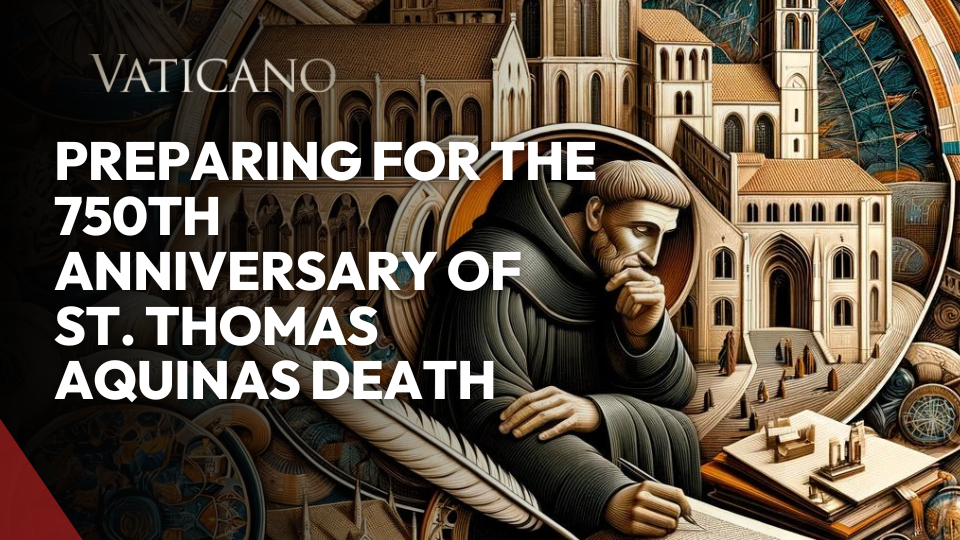
This year, the Catholic Church will commemorate the 750th anniversary of St. Thomas Aquinas’ death. Reflecting upon the eventful life and timeless work of the Angelic Doctor, Father Serge-Thomas Bonino, president of the Pontifical Academy of St. Thomas Aquinas, shared some thoughts about the medieval theologian’s thought.
Fr. Bonino emphasized that “Saint Thomas is, first and foremost, a man in search of God. As a child, the first word we know he spoke is Quid est Deus, meaning, What is God? And so, he is a man who searched for God with his life, with the commitments of religious life, and sought him intellectually.”
Born in the castle of Roccasecca, south of Rome, St. Thomas spent his youth in the Benedictine Monastery of Monte Cassino. After entering the recently established Dominicans while studying in Naples and then further studies and teaching in Paris, the Dominican friar returned to Italy on two occasions: the first time to Orvieto, where he composed the Proper for a Mass and an Office for the feast of Corpus Christi, and a second time to Rome where he served as a papal theologian and started to write his famous Summa Theologiae.
A life entirely of this innate search for God, Fr. Bonino described the last days of St. Thomas Aquinas, saying, “And then, at the end of his life, he returned to Italy after having taught in Paris for a second time, and he went to Naples. In Naples, he was called to participate in the Council of Lyon in 1274, and on his way to Lyon, he stopped at the Abbey of Fossanova. Exhausted, he died in the Abbey of Fossanova.
Although 750 years have passed since the great theologian and Doctor of the Church passed away in the Cistercian Abbey of Fossanova, St. Thomas’s thought did not die with him. Instead, his thought continued to develop over time and is today known as “living Thomism.”
“His theology, his immense work,” Fr. Bonino explained, “has had a very important role in the history of the Church. He is called the Universal Doctor because St. Thomas’ doctrine expresses the fundamental principles of the Christian faith and theology.”
After Aquinas’s death, these fundamental principles, Fr. Bonino continued, “were taken up by his disciples who applied these principles to new problems, and so Thomism is Thomas’s doctrine, but it is also Thomas’ doctrine with all the developments that came with his disciples.”
Building on the legacy of the Dominican order’s first Roman studium conventuale at the priory of Santa Sabina in Rome, the Pontifical University of Saint Thomas Aquinas (the Angelicum) was eventually established in 1908 and given its Pontifical status in 1963. Today, religious laymen and women travel to the Eternal City to study the thoughts of the great Saint.
Bonino stresses that the scholastic Thomistic tradition at the Angelicum forms students from varied cultural and intellectual backgrounds, “The students,” he said, “wherever they come from, are faced with incredible cultural and intellectual challenges. And so, they are looking for a tradition that is well rooted in the history of the Church, that has been and still is very much recommended by the magisterium of the Church, and Thomism gives these students keys and tools to deal with more contemporary issues and challenges.”
Robin Franssen, a first-year student in Philosophy at the Angelicum, was drawn to study St. Thomas Aquinas for his insistence upon the faculty of man’s reason. Franssen said, “I really wanted to deepen my understanding of the Catholic faith, and something that was really striking to me was the rationality of St. Thomas. We live in a world where it is commonly thought that faith is for the ignorant; it’s irrational and unreasonable, but it’s not; it’s blatantly false, and knowing, learning this rationality of St. Thomas that is not only in his philosophy but in his whole faith, really I think helps us not only to understand but also deepen and promote our faith.
This year, the Catholic Church will commemorate the 750th anniversary of St. Thomas Aquinas’s death, an anniversary significant not only for the Dominicans and Thomists around the world but also for every Christian.
Fr. Bonino made the following point: “An anniversary is a way to remember the figure of Saint Thomas, of re-proposing this exemplary figure, not only for Christian intellectuals but also for all Christians. Let us remember that St. Thomas is a Saint, that is to say, a model of Christian life, one who lived his faith to the end. So, this model has not lost any of its relevance. It remains very attractive.”
Gina Pribaz, a student in Spiritual Theology at the Pontifical University of Saint Thomas Aquinas, is comforted by the long-standing testament of St. Thomas Aquinas and his teaching. She said, “750 years is three-quarters of a millennium. That’s something to celebrate, especially in this time of turbulence; that continuity over the centuries is quite a beautiful, comforting thing. It gives me courage in my faith. Pope, theologians, and councils have turned to him and his work all these years, so it’s worth celebrating. Thank God the faith does stand the test of time, and thanks to Saint Thomas Aquinas for giving us such a solid foundation.
Adapted by Jacob Stein