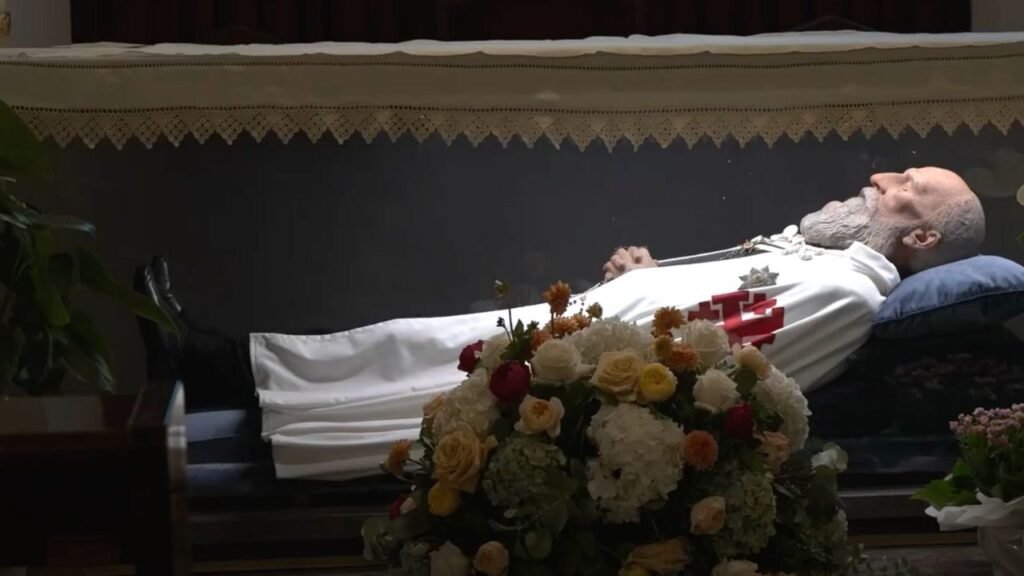
Pope Leo XIV will declare seven new Saints on October 19th; one of them is Blessed Bartolo Longo, the first canonized knight of the Order of the Holy Sepulchre. Formerly deeply involved in the Satanic occult, Bartolo converted to Catholicism after seeking guidance from a Dominican priest who encouraged him to pray the rosary when he was suffering from anxiety, depression, and haunted by terrifying visions. This later inspired him to spread the devotion of the Holy Rosary around the city of Pompei in Italy.
He composed the Pompei novena, 54 days of praying five decades of the Rosary as a means of seeking grace in desperate cases and built the Shrine of the Blessed Virgin Mary of the Holy Rosary. As we enter into the month dedicated to the rosary, the Sanctuary is filling up with pilgrims, locals and tourists gathering to visit his tomb and learn more about the Saint-to be.
Salvo, a Pompei local, says, “What he did for Pompeii was something that nobody else will be able to do ever again.”
Another local, Francesco, adds, “We are the children of Bartolo Longo. I am from this land, I am from this area. Bartolo Longo taught us that the Rosary is life. For me, the Rosary is everything. I say one every morning in bed before I wake up, that is, as soon as I wake up with my wife. Every morning, we have been saying it for more than 10 years. The Rosary is life.”
A tourist to Pompei Alessandro also says, “Bartolo Longo is a person who left his mark here in Pompeii. Not only personally, but also all the people around him, all the people who knew Bartolo Longo, were able to appreciate his spirituality.”
Within the Shrine there is a venerated image of Our Lady of Pompei. It was once a discarded painting and is now the spiritual heart of the Basilica after its restoration by Blessed Bartolo Longo. Numerous miracles and graces have been attributed to this image, drawing faithful from around the world. To this day, it continues to inspire believers to embrace the regular recitation of the Rosary.
“Every Rosary, every Hail Mary is a rose for Our Lady,” says Pasquale Concetta. “And it is wonderful because you feel very close to her and she helps you in all your difficulties.”
Anna adds, “Many people do not believe in miracles. I believe in them because I have experienced one myself. I had a family member, a nephew who suffered a terrible accident. We entrusted ourselves to prayer as a family. And thanks to prayer, to Our Lady of Pompeii, my nephew was saved and is still with us. So, these things strengthen our faith in prayer and in Our Lady of the Rosary of Pompeii even more.”
“The Rosary means keeping Satan away from us; so it helps us to grow well,” shares Francesco. “I don’t know if you’ve ever heard of these visionaries who perform exorcisms, who free people from the devil. The Rosary is the strongest weapon; it is the strongest sword that fights the devil.”
As Catholics take hold of their rosaries this month and turn to Our Lady, the life of Bartolo Longo stands as a reminder that nobody is beyond the reach of Christ and that through the rosary, through Mary, lives can change.
Adapted by Jacob Stein. Produced by Alexey Gotovskiy; Camera by Eelis Lampola