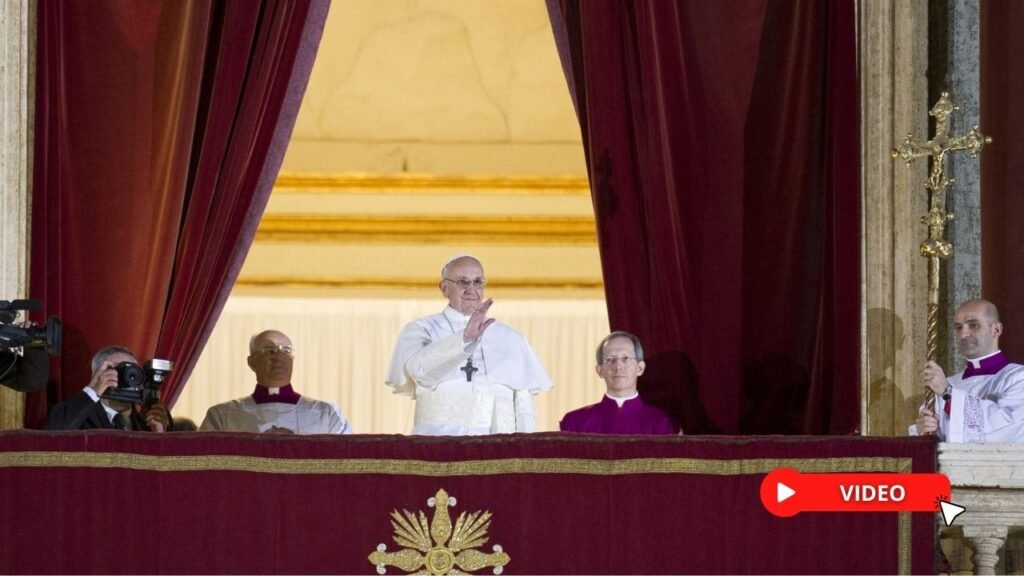
When Cardinal Jorge Mario Bergoglio was elected Pope in 2013, the Catholic Church crossed a historic threshold. For the first time, the Bishop of Rome came from Latin America, carrying with him the faith, wounds, and hopes of an entire continent. Pope Francis did not simply arrive from the New World—he brought a new way of seeing, speaking, and walking with the people of God.
White Smoke and a New Sound
Never before had a Pope come from Argentina. Never before had the Catholic Church chosen a pontiff from the New World. For many in Latin America, the moment the white smoke appeared was accompanied by a sound that felt unfamiliar—and immediately intimate.
Rodrigo Guerra, Secretary of the Pontifical Council for Latin America, remembers that “all of a sudden, the white smoke announced a man who at first did not sound Italian and suddenly we became aware that it was a dear friend of many years, Cardinal Jorge Mario Bergoglio, who had been elected pontiff of the Catholic Church.” That realization unfolded almost instantly into something deeper. “We said he is one of ours,” Guerra recalls, explaining that it was “the feeling that someone who knows our streets, our people, who has smelled Latin America, who knows how Latin American popular religiosity is modulated, was elected Vicar of Christ… what a very, very profound experience.”
Between the Origins and the Living Face of Today
What Francis brought to Rome was not simply a different accent, but a theological vision forged in Latin America. Italian philosopher and politician Rocco Buttiglione explains that “there is one fundamental feature that Pope Francis brings with himself, from Argentina, from Latin America to Rome: a living dialogue between the tradition of the origins and the experience of the living face of today.”
That dialogue, Buttiglione notes, holds together two dimensions that must never be separated. “On the one hand, you have the faith of the people, the popular piety, that in Latin America has become enormously important, and that is the basis of the Theology of the People and of Culture of Pope Francis.” At the same time, “you have the origins. You have a dogmatic theology that has the task of defending the origins, and you have a popular, a pastoral theology that has to elaborate the faith of the people today, and they must stand continually in relation to one another.”
The Walk of the Neighborhood, the Walk of the Church
Francis’ vision was visible from the very beginning, even in the smallest details. In the Villas Miserias of Buenos Aires, the poorest neighborhoods of the city, people recognized it immediately.
Father Adrián Bennardis remembers how “the first images showed the shoes.” For him, that detail said everything. “Well, that sums it up for you: he took the walk he had in the neighborhood. He took it to his walk in the Universal Church.” What many described as closeness, Bennardis insists, was something deeper: “I was talking about closeness and I think it is a theological question, yes, the theology of God’s closeness.”
Francis brought that theology with him, along with realism and openness. “He brought the Church that does not look away when there is a problem but assumes it, even if it makes mistakes, right?” Bennardis says, recalling the Pope’s words from the very first day: “I prefer a church in the field to a Church locked up in the sacristy.” That “church in the field,” he explains, “has been here in these popular neighbourhoods from their beginnings more than 50 years ago.” And Francis, he adds, “basically took that to Rome. He took that ‘poor church for the poor,’ here in Buenos Aires, there.”
A Church Marked by Martyrdom
Along with that pastoral style, Francis carried with him the memory of suffering. Bennardis explains that “he carried the martyrdoms of the 20th century with him, he carried those martyrdoms that sowed the seeds of this Church that is Latin America.” It is, he says, “a young Church, an open Church, a Church in dialogue with reality, a Church that is not afraid to get dirty, an inculturated Church.” That, Bennardis concludes, “is what he brought. And surely the Holy Spirit will continue to give new breaths of life even after Francis.”
Hearing a Pope Speak with Our Accent
The election of Francis was not only an Argentine first. Across Spanish-speaking countries, Catholics felt newly represented. Colombian priest Father Jerónimo Espinosa points out that “Pope Benedict and then John Paul II, they spoke great Spanish, but it’s different to hear him with a different accent, an Argentinian accent.”
For many, he explains, “to hear him in our own language, it was a beautiful moment,” especially because “he understood us and he knew where we were coming from and knew where we wanted to be too.” That connection became unmistakable at World Youth Day. “We were like 3 million people in Copacabana and it was an amazing experience,” Espinosa recalls. “To hear him in our own language and of course that World Youth Day was of course tons and tons of Latin Americans and from there it was like, OK, this is how it’s going to be. Not in a bad way, but it was just different.”
A Latin Way of Speaking the Faith
Mexican Archbishop Jorge Carlos Patrón Wong, who worked closely with Francis in Rome for eight years, describes the Pope as a unique balance of strength and freshness. “So there is a combination of maturity and youth and Pope Francis is noticeable because there is a theological and ecclesiastical maturity but at the same time a very practical dynamism.” That dynamism, he adds, is unmistakably Latin American.
It shows above all in communication. “The language of Pope Francis, his way of communicating is very Latin American, with words, gestures, images that are very close to the people but that have an extraordinary theological and religious depth.”
A Pope Who Never Left Latin America Behind
Throughout his pontificate, Francis returned again and again to Latin America. Emilce Cuda recalls that “in Brazil, the connection with young people—who are not the future but the present—supporting the Pope and the youth of Pope Francis was very significant.”
She points to Chile and Bolivia, especially “the meeting with popular movements, and his address in Santa Cruz de la Sierra,” where Francis insisted “that there is a need to turn passion into community action, which I would say is politics—and the best kind of politics.” In Colombia, “where this historic, long, and slow journey of social dialogue and peace was taking place,” his presence mattered deeply, “to bring visibility to the process and to listen to all voices.” And in Mexico, she remembers that “his messages to the bishops and his dialogue with them were among the strongest I can recall… while also maintaining a spirit of reconciliation.” In every country, Cuda concludes, “the Pope has touched precisely those key issues that serve as the foundation for a hopeful future.”
A Pope Seen as a Person
For Latinos in the United States, sharing a culture with Francis offered a particular closeness. Jose Manuel de Urquidi explains that “I think it has been a very unique thing for Latinos to see he’s a person, right?” Unlike previous pontificates, “we’ve never had a Pope that was chosen as a Pope and then he became this angel or this living Saint, not at all.”
Instead, Francis feels familiar. “He has been very close and he’s spontaneous sometimes he says things that we Latinos get because of the context or the culture or the background and the lived experiences,” de Urquidi says, noting that “maybe it’s easier for us to understand that than maybe other people in other cultures.”