For eight centuries, pilgrims have traveled to Assisi to pray near the tomb of St. Francis of Assisi. But in 2026, they were given an extraordinary opportunity.
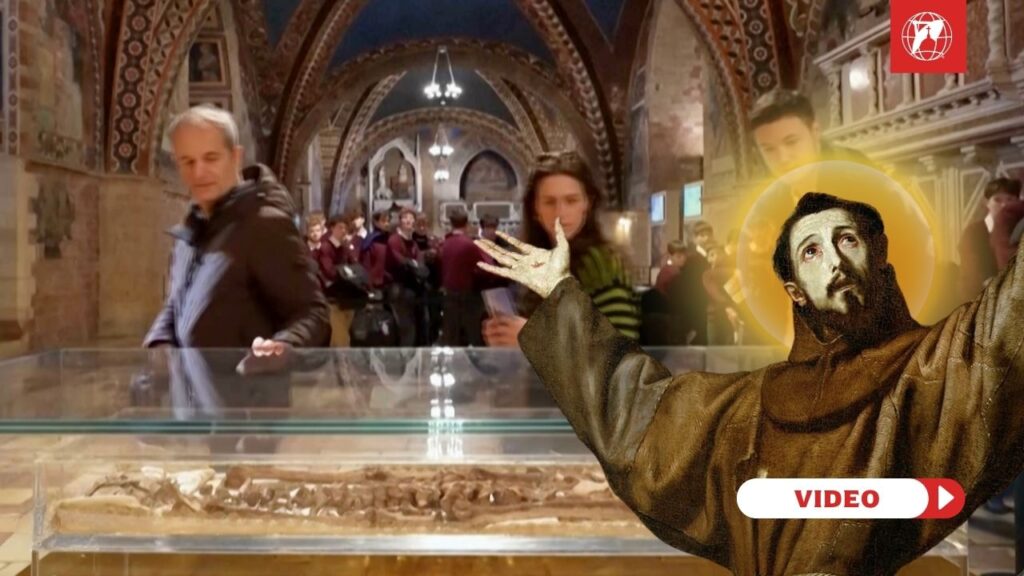
For one month, the mortal remains of St. Francis were placed on extended public display, allowing the faithful to venerate the relics of one of the Catholic Church’s most beloved saints.
The response was remarkable.
Between February 22 and March 22, 2026, more than 370,000 pilgrims from around the world came to Assisi to venerate the relics.
The historic exposition formed part of the celebrations marking the 800th anniversary of the death of St. Francis. Yet for the Franciscan friars who care for his tomb, the anniversary was about far more than remembering a man who died in 1226.
Their message was simple: “St. Francis Lives.”
“St. Francis Lives”
San Francesco Vive — “St. Francis Lives” — was chosen as the theme for the 800th anniversary of Francis’ death.
The words express a conviction that Francis’ influence did not end with his death. His way of following Christ continues to inspire Christians around the world.
“I know that Francis is alive,” said Fr. Francesco Piloni, OFM, Minister of the Province of the Friars Minor of Umbria. “He is alive in all those who have a deep desire to live the Gospel way of life.”
Francis continues to attract people because of the radical simplicity of his witness.
He embraced poverty. He sought fraternity. He preached peace. Above all, he tried to make the Gospel the foundation of his entire life.
Eight centuries later, Fr. Piloni believes that witness still awakens something in people: a desire to return to a simpler and freer way of living the Christian faith.
The extraordinary number of pilgrims who came to Assisi in 2026 offered visible proof of that enduring attraction.
The Hidden Remains of St. Francis
The story of Francis’ relics stretches back almost eight centuries.
St. Francis died in 1226. In 1230, his body was transferred to the basilica built in his honor in Assisi.
For centuries, however, the precise location of his remains was hidden.
That changed in 1818.
Excavations inside the Basilica of St. Francis eventually led to the rediscovery of his body.
Fr. Marco Moroni, OFM, Custos of the General Custody of the Sacred Convent of St. Francis in Italy, describes Francis’ tomb as the “radiant heart” of the basilica.
After the remains were rediscovered, they were examined and returned to the tomb where they remain today.
The discovery brought pilgrims physically closer to the man whose life had transformed Assisi and left a permanent mark on Christianity.
But opportunities to actually see his mortal remains remained exceedingly rare.
The Extraordinary Examination of 1978
Before the 2026 Franciscan Jubilee, the relics of St. Francis had been publicly visible only on an exceptional occasion in modern times.
In 1978, with the authorization of Pope Paul VI, the saint’s remains were removed from the tomb and scientifically examined.
The examination offered an unusual opportunity to compare the physical remains with descriptions of Francis found in ancient sources.
The findings were striking.
According to Fr. Moroni, they confirmed an important detail preserved by tradition: Francis was a man of small stature.
The discovery fits beautifully with the saint who called himself “little Francis.”
Yet his physical stature stood in contrast to his remarkable determination.
“He was indeed a small man with great tenacity and great strength of spirit,” Fr. Moroni said.
The 1978 examination was carried out discreetly, at a time when news did not travel with the speed it does today. For a brief period, people in Assisi and those who learned of the event were able to see the saint’s remains inside the Sacred Convent.
Nearly half a century would pass before the faithful were given such an opportunity again.
370,000 Pilgrims Come to Assisi
The 2026 exposition was on an entirely different scale.
For a full month, from February 22 to March 22, pilgrims were able to publicly venerate the remains of St. Francis.
More than 370,000 people came.
They arrived from different nations, cultures and backgrounds, united by a desire to draw closer to the saint who had died eight centuries before.
For the basilica, the extraordinary turnout revealed something deeper than devotion to a historical figure. It demonstrated the universality and timelessness of Francis’ message.
Fr. Giulio Cesareo, OFM, Director of Communications for the Franciscan Convent, explained why the centenary’s motto was so fitting.
“For 800 years, Francis has remained a gift,” he said.
People still come to Assisi seeking Francis’ intercession. Some ask for a grace. Others seek consolation or direction. Still others encounter in his life a challenge to reconsider their own priorities.
Francis remains deeply countercultural.
His embrace of poverty challenges the pursuit of possessions. His fraternity challenges division. His humility challenges ambition. And his commitment to peace stands against a world repeatedly wounded by conflict.
The pilgrims who came to his relics were therefore not simply visiting the remains of a medieval saint.
They were encountering the physical testimony of a life that still asks difficult questions.
Why Catholics Venerate Relics
The public exposition also points to the ancient Catholic practice of venerating relics.
For Catholics, relics are not worshipped. Rather, they are honored because of the holy men and women to whom they belonged.
Christianity is a profoundly physical faith. God became flesh in Jesus Christ. Christ suffered, died and rose bodily from the dead. The Christian hope also looks toward the resurrection of the body.
The bodies of the saints therefore matter.
They are reminders that holiness is not an abstract idea. It is lived through real human lives.
In the case of Francis, that physical connection carries particular significance.
This was the body of the man who embraced lepers, walked the roads of medieval Italy, rebuilt ruined churches, preached the Gospel and bore the stigmata associated with the wounds of Christ.
The relics bring pilgrims face to face with the reality that Francis was not merely a legend.
He lived.
Pope Leo and the Call to Become Witnesses of Peace
The exposition took place within the wider Franciscan Jubilee Year, proclaimed to commemorate the 800th anniversary of Francis’ death.
For Pope Leo, the anniversary is not meant to remain focused solely on the past.
In the decree announcing the Jubilee Year, the Pope prayed that Christians, following the example of St. Francis, might themselves become models of holiness and constant witnesses of peace.
That message has particular urgency in a world marked by war, division and uncertainty.
Francis himself lived amid political conflict and social upheaval. Yet he became known across the centuries as a man of peace.
For Fr. Moroni, that peace remains palpable in Assisi.
“Francis continues to radiate peace,” he said.
But visiting Francis’ tomb is only the beginning.
The deeper challenge is to receive the peace of Christ and then carry it into the world.
More Than Relics
Eventually, the extraordinary public exposition came to an end.
The pilgrims returned home. Francis’ mortal remains returned to the place where they have rested for centuries.
But the message of the Jubilee remains.
The relics drew more than 370,000 people to Assisi because they offered a rare physical encounter with one of Christianity’s most recognizable saints.
Yet the Franciscan friars insist that Francis is not confined to his tomb.
He “lives” wherever Christians take seriously the Gospel he tried to embody.
He lives when people choose peace instead of conflict, fraternity instead of division, simplicity instead of excess, and service instead of self-interest.
Eight hundred years after his death, hundreds of thousands came to see the mortal remains of the “little Francis.”
Perhaps the greater question is what they carried away with them.
Because the enduring legacy of St. Francis is not simply something to be admired in Assisi.
It is a way of life meant to be lived.
Adapted by Jacob Stein. Produced by Bénédicte Cedergren.