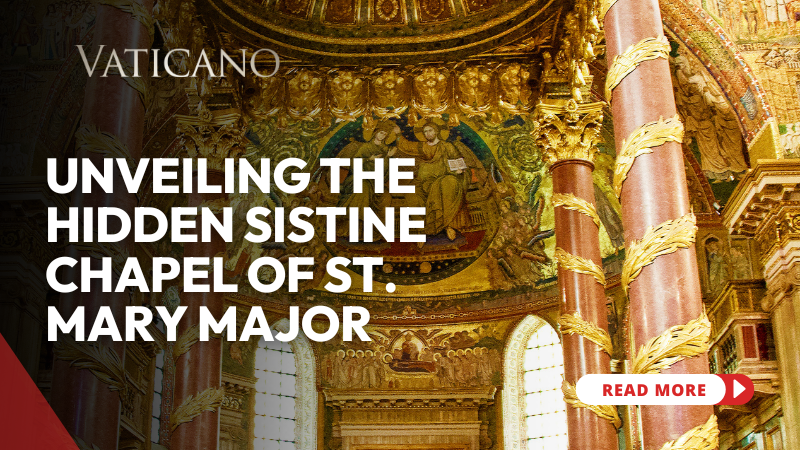
The Basilica of St. Mary Major boasts its own “Sistine Chapel.” Unlike the famed Vatican chapel, it doesn’t feature Michelangelo’s “Last Judgment” or frescoes of the creation of man. However, it does include Michelangelo’s touch on one of the world’s largest tabernacles and houses the first-ever Nativity scene.
Guido Sante, conservator and restorer of the Basilica, shared with EWTN Vatican, “We now call it the Sistine Chapel to honor Sixtus V.” Originally, the chapel was known as the Nativity Chapel, built to commemorate Christ’s birth and house the Holy Cradle relic from Bethlehem. “This location, near our current spot, held the first oratory and church dedicated to Christ’s Nativity, sheltering the relic,” Sante explained.
Faced with preserving this significant chapel, Pope Sixtus V and his architect, Domenico Fontana, undertook a remarkable task. “They couldn’t demolish the ancient chapel containing the Holy Relic. Instead, they encased it and moved the entire structure under the altar in the Sistine Chapel of St. Mary Major,” said Sante.
This medieval chapel, resembling a crypt or confessional, continues to hold the Holy Relic of Bethlehem. “Pope Sixtus V also commissioned a chapel to honor the Nativity scene envisioned by Nicholas IV, the first Franciscan Pope. This chapel still preserves the first Nativity scene in history,” Sante added.
The tradition of the Nativity scene, initiated by St. Francis in Greccio, quickly spread. The “creche,” as we know it, originated in the small chapel of St. Mary Major’s Basilica, alongside Bethlehem’s Nativity relics.
The altar complex, embodying the Tridentine Council’s spirit, features a tabernacle built following St. Charles Borromeo’s guidelines. Borromeo, a prominent figure of the Catholic Reformation from the Council of Trent, served as archpriest of St. Mary Major.
Sante emphasized the tabernacle’s alignment with the Nativity Chapel, indicating its theological significance. “As Pope Sixtus desired, we witness the Incarnation of Christ, represented by the Holy Cradle relic and Nativity scene.”
The Council of Trent’s teachings on Christ’s Real Presence in the Eucharist are highlighted by the tabernacle’s placement. “Located next to the altar, the tabernacle forms a vertical line leading to the dome’s center, where a choir of angels depicts God the Father. This design represents a journey from Christ’s Incarnation to God’s glory,” Sante described.
The tabernacle’s construction and decoration, using some of the 16th century’s most precious stones, reflect its importance. “Pope Sixtus spared no expense to create the city’s most precious tabernacle,” Sante noted.
Michelangelo’s influence extends to this Sistine Chapel as well. “Above, there are depictions of the 12 Apostles and eight scenes of Christ’s Passion. At least three scenes, made from gilded bronze, are based on Michelangelo’s designs,” Sante revealed.
The tabernacle stands as a historical and spiritual testament to the Catholic belief in Christ’s Real Presence and the memorial of His Passion, death, and resurrection.
The next EWTN Vatican series installment will explore another Basilica treasure: the ancient icon Salus Populi Romani, attributed to St. Luke.
Adapted by Jacob Stein.